So, now that the last week of classes not just for me but for everyone is finally upon us, I have the time to finally breath and relax. I’ll get about a month off before I descend into the final semester of my college life, and then after that? Well, we’ll see. Either way, the largest project I’ve completed in my schooling life, and my favorite one is finally finished. I’m extremely happy with the final product no matter what happens. I know I was able to pour out all the love I have for the city of Kyoto into one project, and it really feels like this is a ‘magnum opus’ for me, even though I’m still in school for another semester. It would have been more poetic if I finished the COGS alongside the rest of my graduate work in the spring, but I’m certainly not going to be complaining that it’s done now, for the pure fact that after I finished this, I think I can finish any project.
The week consisted of nothing but some edits to the text itself, cutting out a few bloated lines and cleaning up the rest of my typos. It was surprisingly easy, and when I found myself finally finished I had the time to reflect on just how close to being done school I really am. I’m really only four classes away from being done, and while I wouldn’t like to HAVE to do a class in the first summer semester, I expect it to be relatively easy if time consuming. After that? Well, I’ll hope for my application to the JET program to come to fruition, however, even if it doesn’t I have a few plans to fall back on once school is done. I plan on applying to be in the adjunct pool, I have my job at the National Constitution Center, which I’m hoping comes to fruition with a full time job at some point, I have my foot in the door in multiple places and know this will be okay.
And beyond my professors and peers, I have the city of Kyoto to thank for this incredible moment. I won’t forget those first few moments walking through the city by myself. I had never been one to admire scenery and really appreciate how a city is built. However, that was not the case in Kyoto. They say the city is the most holy in Japan, in history it was the city of Buddhism and culture, it’s the city where The Tale of Genji and The Pillow Book were written, where Oda Nobunaga became master of Japan, where Minamoto no Yoshitsune marched, where Raikou set out to fight Shuten Douji. So many of the great people and moments I studied in history took place in this one city, and they’re what inspired me to not only do this project, but also be a historian.
So, as I finish up my ‘Magnum Opus’, all I have to say, is thank you Kyoto.
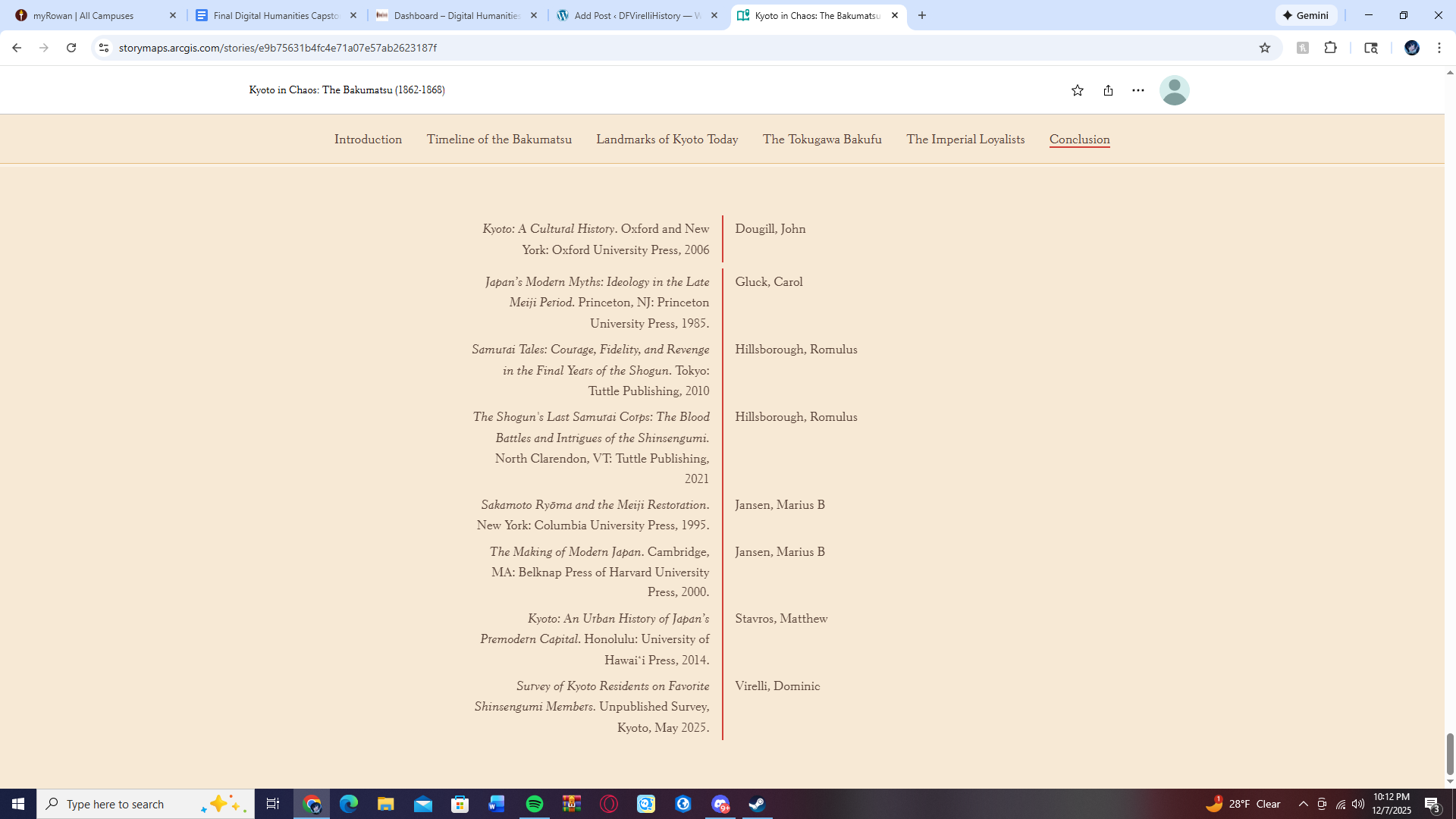
So, a week after finally being able to present all of the meticulous research I’ve done for months, I got some time to breath. For other classes, I only had one short final paper for Dr. Hague, and now I’m finally able to wrap up everything for both classes. This week, as opposed to the previous few months of constant nights with hours of work, I was able to relax and put together my bibliography while scouring my Story Map for any and all typos that made their way through my last round of editing, and yes, there were more. And I’m sure there will continue to be more each time I look, but that’s simply something I’ve come to accept.
Of course, that is partially a joke. The real reflection I’ve done as I sit down to write this blog post and the final reflection paper for the capstone, I’m amazed at just how quickly the time went by.
After graduating at the end of last spring, I left for Japan the next week. I spent ten days in the country I’ve spent the last three years studying, after I got back, I started a job which was a chance of a lifetime at the Penn Museum, which then got my another job, and now my current job which has set me on the path to a museum education and programming career. The semester started, and now here we are at the end. And I am STILL in disbelief that it’s all past what’s felt like in a flash.
However, putting together my bibliography has put it all into perspective. I found myself not having to reference any of my research material nearly as much as I had to in previous papers and projects, that’s simply because I’ve read these books so many times the information is already burned into my brain, so I really only found myself referencing it for dates, spelling and small details surrounding events or figures of the Bakumatsu.
Getting this ready into a regular google doc was easy enough, and of course I made sure to put together the full citations. Some of these books, I was even able to buy in Japan itself when I was there, so it was almost as if I was going back on a journey through my years of research on the topic. My friends among the Shinsengumi and the Imperial Loyalists have yet to let me down.
One of the things I took away the most from presenting this research to everyone, was the fact all who listened could see my passion for it. I feel like if I can show the passion I have for it, that will also show in my work as well. So, despite all the great feedback I got from the group of my peers and teachers, that was the most rewarding past of the presentation. I was able to do what I have been setting out to do since I started making projects like this, and that’s to shed a light on Japanese history, and make it easily accessible and interesting for people who have never seen it before.
It was a successful week, and a semester, now only one’s left to go.
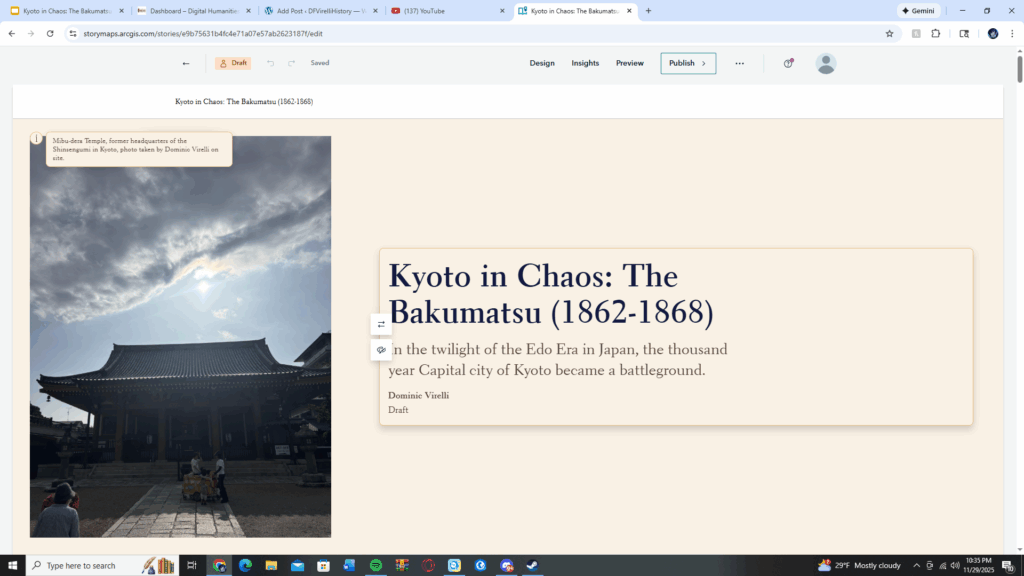
So, after 6 months of planning, across two countries, dozens of pages of reading, and probably subjecting myself to carpal tunnel in right wrist, we’re finally finished. Of course, over the next three days I’m going to obsessively read over my StoryMap, and I won’t officially hit ‘Publish’ on it until the tuesday before my public presentation, since I want to get feedback from the private presentation in class, and make absolutely sure I want to change nothing. Publishing also thankfully gives you a QR code that I can copy and paste into my slides, and after that I’ll create a bitly link so that everyone during the lunch can click through the StoryMap.
As December 3rd finally is coming around, I am really taking the time to reflect on what was my first real historical project about Japan. Of course, Dr. Hague was kind enough to let me write about foreign influences on the Meiji Restoration for my undergrad seminar, but that included research into the European side of things. This project, is what I always wanted, fully in-depth research into my specific period of study, into the period that I’ve spent the last few years studying. It also felt like it went by in the blink of an eye.
At first, I had planned on a database and map of major battles of the Sengoku Period (Warring States Period) of Japan, but quickly I realized that was not feasible in my timeframe for that was WAY to broad. It wasn’t until I walked through the streets of Kyoto in Japan, along the Kamagawa River to the Sanjo Bridge, where so many of the historical events I really studied had happened the idea finally came to me. That, combined with the Kyoto locals I was able to speak to (albeit through broken Japanese and translator) about this period I’ve been so passionate about studying really was what let me put my idea together.
The Bakumatsu, is full of what I love most about history. Interesting people with different sides to them, clashing ideas, and quite a bit or irony, since in the end both sides of the Restoration wanted the exact same outcome but had wildly different ways of wanting to go about it. Of course, years upon years of bad blood boiled over as well, but that still drips with irony.
Also of course, there’s the giant anime sized reason in the room. The reason I even learned about the Bakumatsu in the first place was that I played Fate Grand Order and saw Okita Souji. This really ties back into my YouTube video project last year, and what I want to accomplish with any kind of project I put out into the public space. I want to make it easier to access and understand for people who may be intimidated by the difficulty of reading a 500 page non-fiction book. I want to somehow open up avenues for people like me, who see something REALLY cool and historical in say a video game, anime or movie, and want to learn more right away but don’t have four years to become proficient at close reading and textual analysis.
I like to think that I’ve accomplished that at least a bit with both my video last year, and this project here.
The concept for this project started all the way back on the streets of Kyoto itself in the month of May. Originally, my project was going to be a database of battles during the Sengoku Period, the warring states period from 1450-1600 since that would be a good era to map out making the map more visually appealing. However, it’s safe to day walking along the streets of Kyoto, seeing the sites of all the places I’ve visited, seeing the shops selling Shinsengumi merchandise, it convinced me that I could do something different. So, this summer in between going and working at camp at Penn, I continued my usual studies on the Bakumatsu period, but diving deeper into specific events I knew I’d want to use for my project, as well as how these events shaped the future of Japan and their memory of the men of this era.
Why was I able to eat at a Shinsengumi themed restaurant? Why was I able to buy a coffee mug with a portrait of Sakamoto Ryoma on it? Why in almost every samurai era anime that I watch, do I see Okita Souji and Hijikata Toshizo? Why would Tom Cruise be in a movie about Saigo Takamori? Why the heck did so many people in Japan love this era? I’ve realized there are two answers to this, the more complex one, is that in the following years into the Meiji Restoration, the new Meiji Government had descended into an Oligarchy, and in the drafting of their constitution, they needed a way to unite people. When was the last time they were reunited? The end of the Edo Period during the Bakumatsu. So, the heroes of the Bakumatsu on both sides became venerated, as the government invoked their names with nostalgia to help spur together national unity. However, a much more simple answer, lies in the Japanese culture and mindset itself. In Japan, Confucian veneration of the family and ancestors is extremely relevant, themes like honor, sacrifice, ‘samurai honor’, were pillars of their society. So, it’s only natural that for years to come, the samurai of old who shaped their country would become venerated by the people.
In terms of finishing up the timeline and StoryMap, all of the information is down. I added in a clean navigation bar, and used the preview feature to see what it would look like on an actual computer. I’ve adjusted the size of some of the maps, and saw how much I need to cut out of some of my descriptions. This entire week now, is going to be purely dedicated to editing down my descriptions, and FINALLY getting some images and pictures into it, and I believe most are going to come from my own trip to Kyoto.
I also made the decision to include in some of the descriptions, the results of a very small and informal survey I took for fun in Kyoto. I asked twenty locals who I met while in the city, who their favorite member of the Shinsengumi was, and sure enough all twenty had answers, that data is going to be included to help show the popularity of the group, and the veneration the people of Kyoto have for them now.
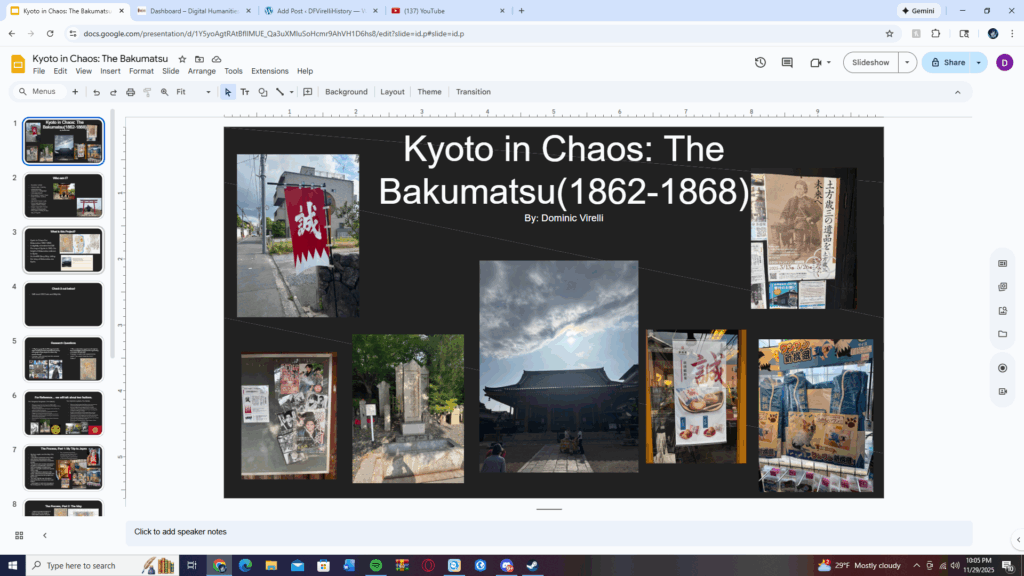
Then, over the weekend, is when I will put together my presentation, while in theory it should be easy, the harder part will be deciding what to say for each slide, however, I’ve learned over years of giving presentations that I work best when there is no script in front of me. The hard part will certainly be only keeping it to around ten minutes, normally I’d try to keep the slides minimalistic, but I find when I try to limit myself I more often then not cut TOO much, so I’ll try and find a good balance over the weekend.
Either way, nearly six months of work is finally coming to a head next week, it’s a crazy feeling. I just know I’ll need a long nap afterwards.
Just like I expected, this was probably the most fun I’ve had on any project for any class in the entirety of my college career. I’m painfully aware I’m probably going to have to re-write some of these sections, but I’ve finally, FINALLY after all these years gotten to do what I always dreamed of for a history class.
Write about Japan, and specifically, what I’m an expert on in regards to their history.
As I mentioned in my last post, after getting the Story Map formatted, this week was all about filling in the stories with all of the information I’ve gathered about this period of Japanese history over the years.
I finally reached the point where I can focus less on the digital side and more on the history and research side (after all we are still in a history class), which has been a welcomed change. After weeks of sitting at my computer, going back to old fashioned notes, annotating and drawing out important facts was such a welcomed change, especially since I’ve been able to weave this all into my new work schedule.
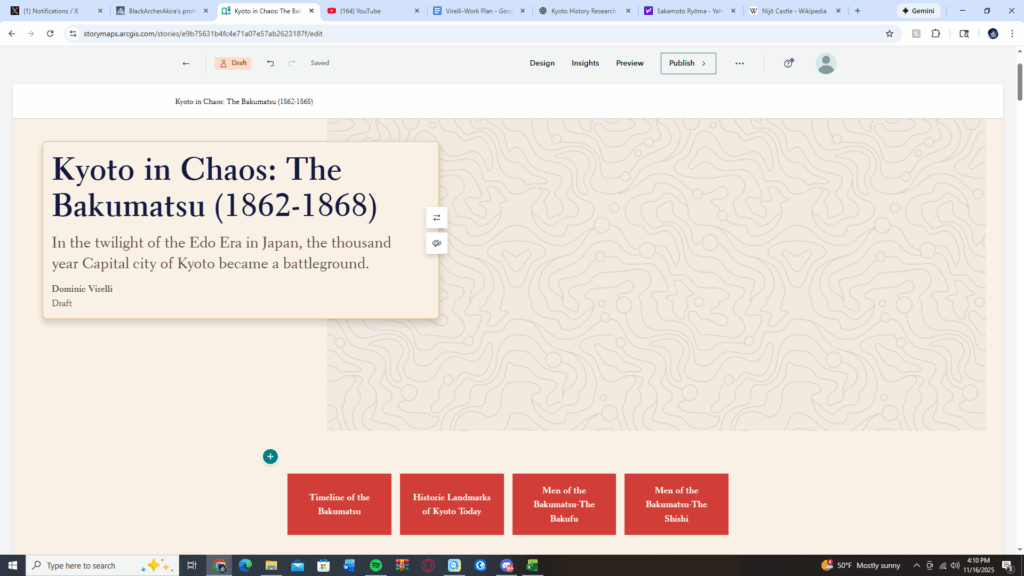
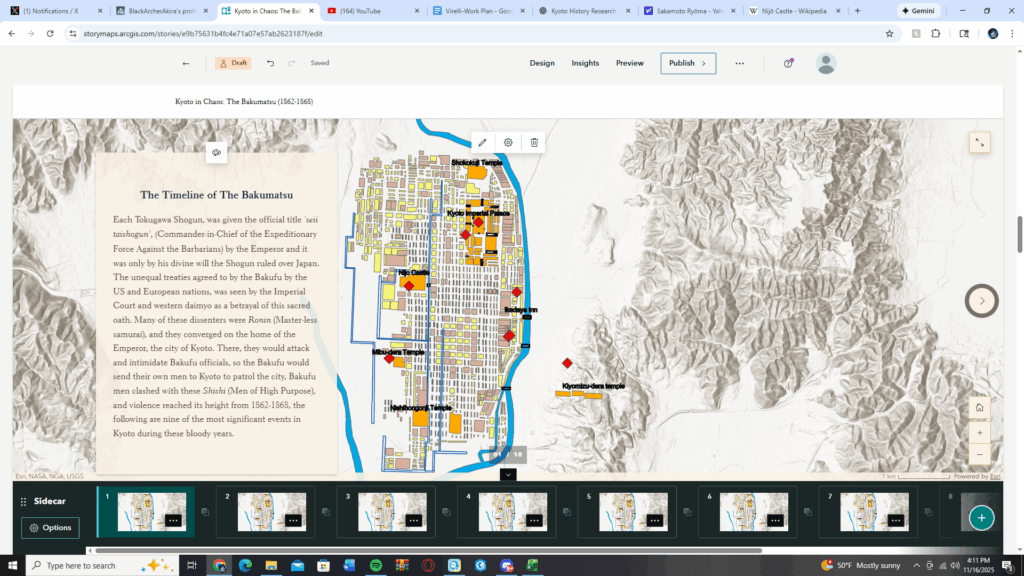
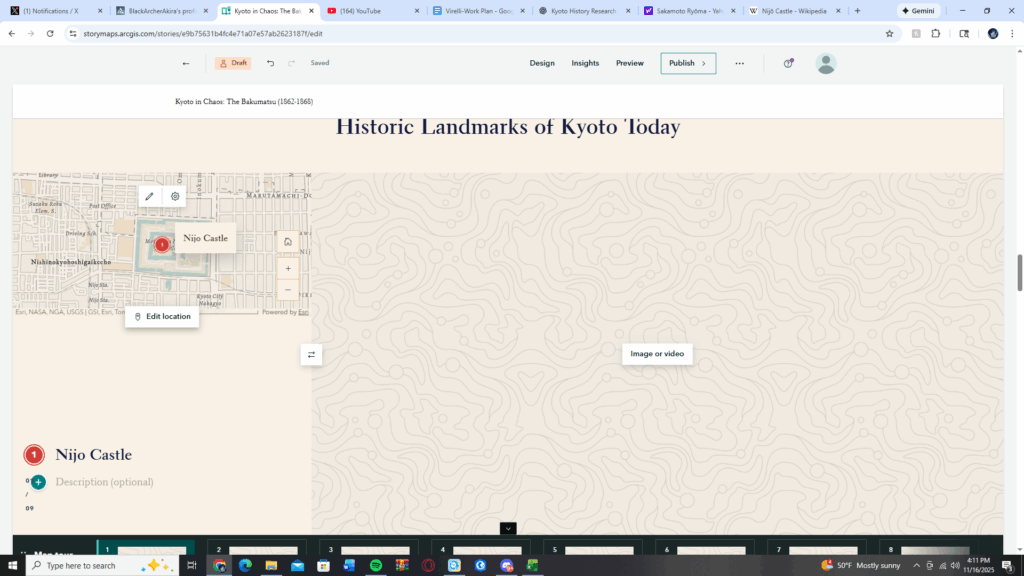
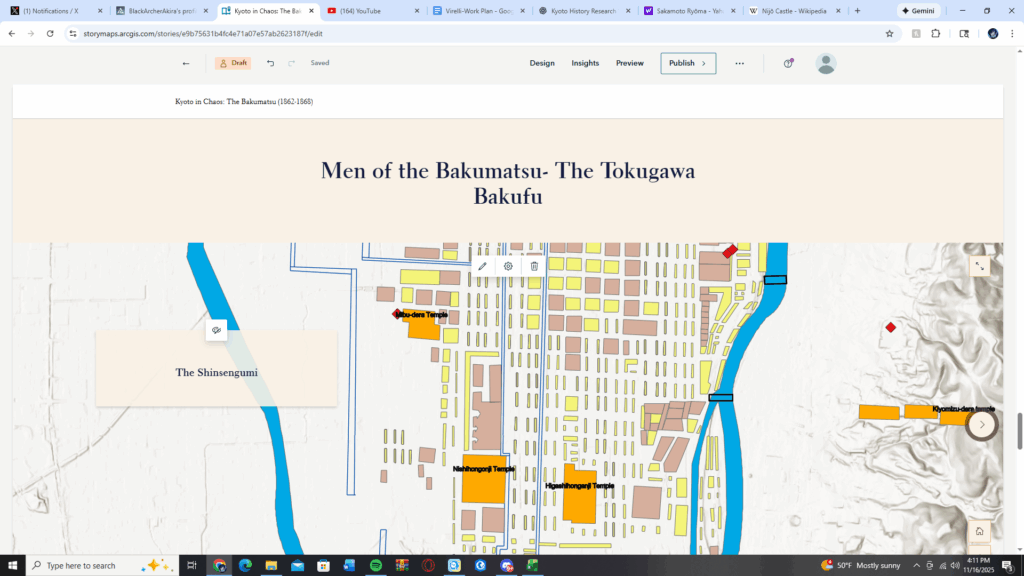
So, as I mentioned in class before as well, I’ve broken this story map up into three sections, 1. The Timeline of the Bakumatsu, 2. Historical Landmarks of Kyoto Today, 3. Men of the Bakumatsu (Both Imperial Loyalists known as Shishi, and the Tokugawa Bakufu). I’ve become well acquainted again with the Shinsengumi, Sakamoto Ryoma, Emperor Meiji etc, and have been able to do the deep dives into this era like I’ve done in the past.
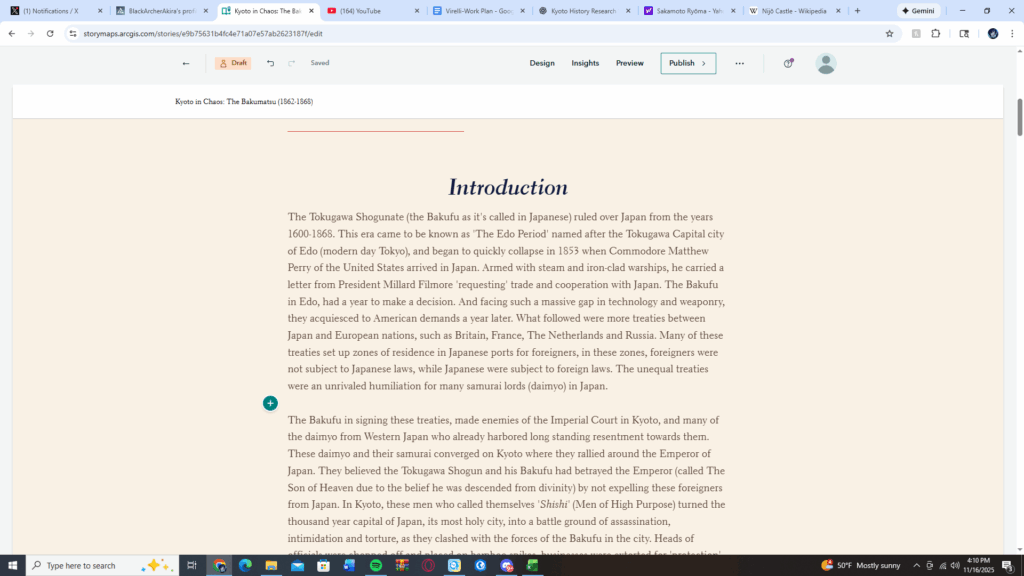
One thing people will notice from the screenshots is the lack of images, and I decided those will come later. I’ve been uploading my own pictures from my trip to Kyoto and will begin adding those after I’m satisfied with the information and research present in each of the sections. I don’t predict that taking more then a day, which gives me plenty of time to focus on the content.
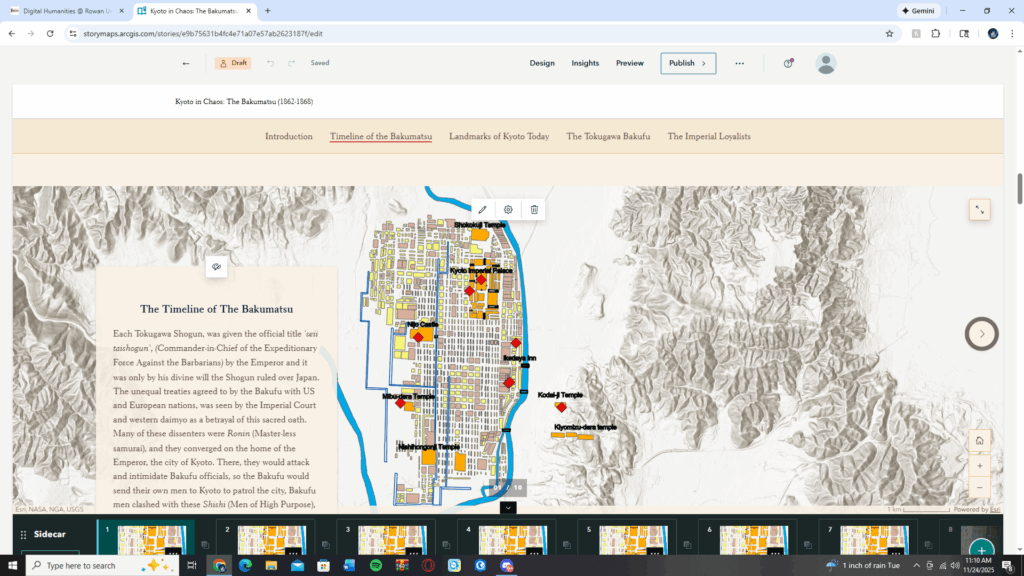
The Timeline of the Bakumatsu, is what I managed to finish first, and it was a pure delight to be able to go back and really dive deep into these events. I don’t expect everyone to dedicate time to reading each of the write ups right now, but I really do think I’ve crafted a well thought out timeline. One thing one will notice during the events, is how power in the conflict shifts. From 1862-1865, it was the Tokugawa Bakufu in large part thanks to the Shinsengumi who have the advantage in Kyoto, however, in 1866, when Sakamoto Ryoma brokers the Satcho Alliance between Choshu and Satsuma domains, the momentum shifts back to the Imperial Loyalists. I made sure to mention the recurring individuals, old locations, I really believe it is some of my best work.
As for the final two sections, the Historic Landmarks of Kyoto Today, and the Men of the Bakumatsu sections, I anticipate easily having them both finished by the end of this week, perhaps in only a day or two. That will leave me all of next week, to add in my images, edit and re-write my sections, and clean up any edits of the map that I may need. Also, it will give me time to craft my presentation of this project. I’m a bit upset that the presentation will be more focused on the process of crafting the project, as opposed to the actual content itself, but either way I’m looking forward to being able to present this in front of my colleagues, and teachers who have been on this journey with me for years as I close in on my Graduate School graduation in the Spring.
And it is in part thanks to my best-friends in the Tokugawa Bakufu and the Imperial Loyalists!
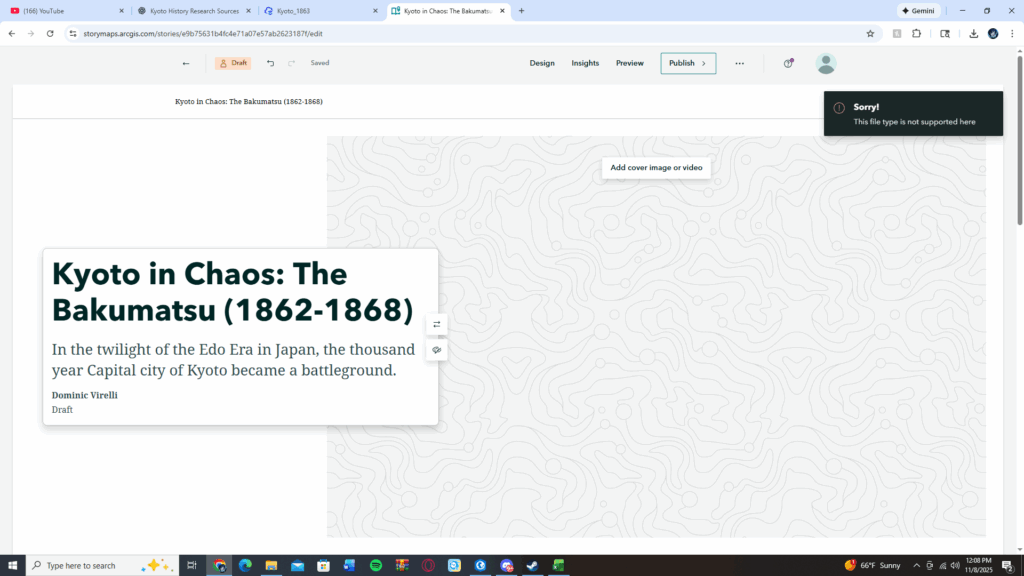
So, now that my schedule is finally set, and I am only working ONE job instead of two or three, it’s finally time to get back onto the schedule I originally had. And crazily enough, I did just enough to be able to be on schedule to be finished everything-barring revisions of course-by the end of next week. I got all of my layers over from ArcPro to ArcOnline, and I’ve added the spreadsheet points, and even started setting up my StoryMap. That’s going to take a day or two to re-familiarize myself with the layout and functions of the StoryMaps, but except for that I really do only have to add in the content for all of the slides and points.
Seeing the points finally spread out on the map, the most difficult part here was simply picking out the events I wanted to highlight. It was hard since there could be twenty or so points here, but these were the ones I had the most to discuss about, and more importantly have the exact location of. My idea for the story map, is these points being highlighted to tell the overall story of the Bakumatsu, which will the main draw. After that, I’ll highlight different people from the Bakumatsu, the landmarks of Kyoto, and ‘Bakumatsu today’, which will have any modern day depictions of these people, showing how these men of violence became immortalized as cultural touchstones.
Now, while I expect adding in content and my research into the StoryMap will not take long, I’m going to encounter my old enemy. My tendency to write too much. I remember when I turned in the rough draft of my seminar paper two years ago, the very first thing that Dr. Hague told me was ‘yeah you need to shorten this’. For reference, the paper needed to be 25-30 pages, my rough draft was near 40. And even when I managed to edit it down to 30 pages, I felt it would have been much better with the 40, when in reality I know that trimming it was best since I got way too into ‘too much information territory’. So, when I’m writing out things like what this timeline will be, I need to really make sure that I prepare and trim down what I have in notes about each of these events into what is only necessary.
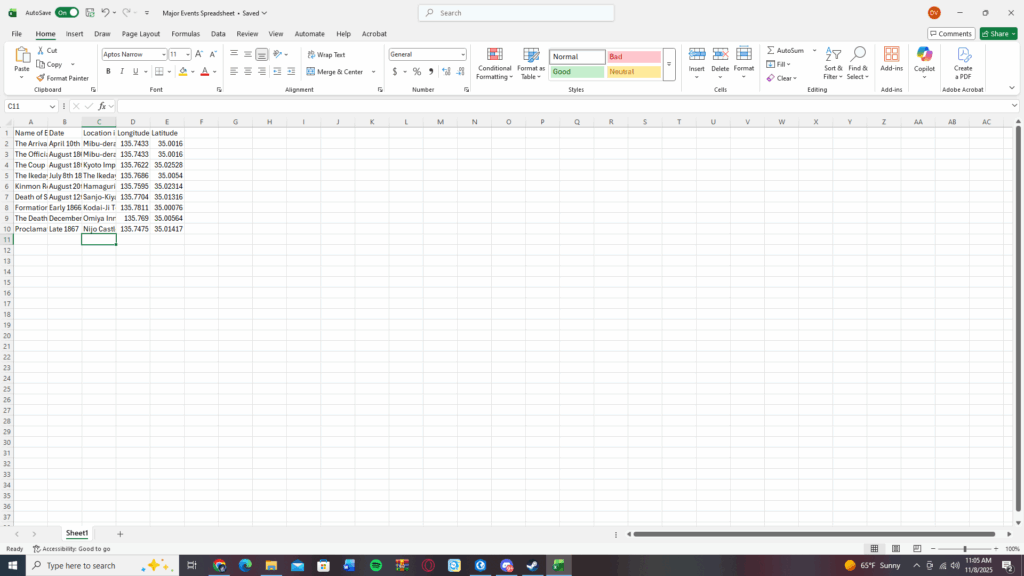
I painstakingly had to narrow the list of points down to only these 9. It was going to be ten, but I had the problem of not being able to find any events between these that had the perfect mix of importance, crucial figures from the period, and enough information in my notes to write out a dedicated slide. Still, these are what I believe are 9 of the most prevalent events of the Bakumatsu era that will let me better tell the people who come across this project about the impact Kyoto in this era would have on not just the city itself, but the entirety of Japan going forward.
I had mentioned this would be a problem at our last class meeting, but I’ve quite literally not been able to get any kind of work done this entire week. Tuesday found me at class all day, and then from Wednesday-Saturday I got to know the city of Philadelphia very well. Starting at the Constitution Center on Wednesday, I was also still committed for another few weeks at Eastern State Penitentiary as well. Which meant I would roll into the Constitution Center around 8:30 or 9am, work until around 4, drive over to Fairmount Ave and then be at Eastern State from 5, to late into the night. My record was until 1am this past Friday, so suffice to say I have not been at my computer for anything until typing out this blog post.
However, like I also mentioned to our group, I planned ahead for this. The map is finished for now, and next up is my list of events during the Bakumatsu into a CSV spreadsheet, and I have that prepared. This is where my already existing knowledge and research comes in, since it’s quite easy to pick up one of the dozens of annotated books on my shelf to pull out the events for the spreadsheet along with their dates and description of the event. Thanks to this, I could possibly even finish all the points into the spreadsheet in a single day or two. The StoryMap, is where a lot of my time is going to go as we transition into the month of November.
I believe firmly now the StoryMap is going to end up being the centerpiece with the Map supporting it. It’s going to give me the chance to talk about what has slowly become over the last year my specific specialization in my historical research. The transition, between the Feudal government of the Tokugawa Shogunate, to the modern Republic/Parliamentary style government we saw take over is fascinating of itself, but how these periods of blood revolution and political violence is remembered fascinates me even more. Allow me to share the humorous, completely insane question that I asked myself a year ago in the middle of my research that led me to this rabbit hole of information. Why in the hell did they turn that samurai into an anime girl?
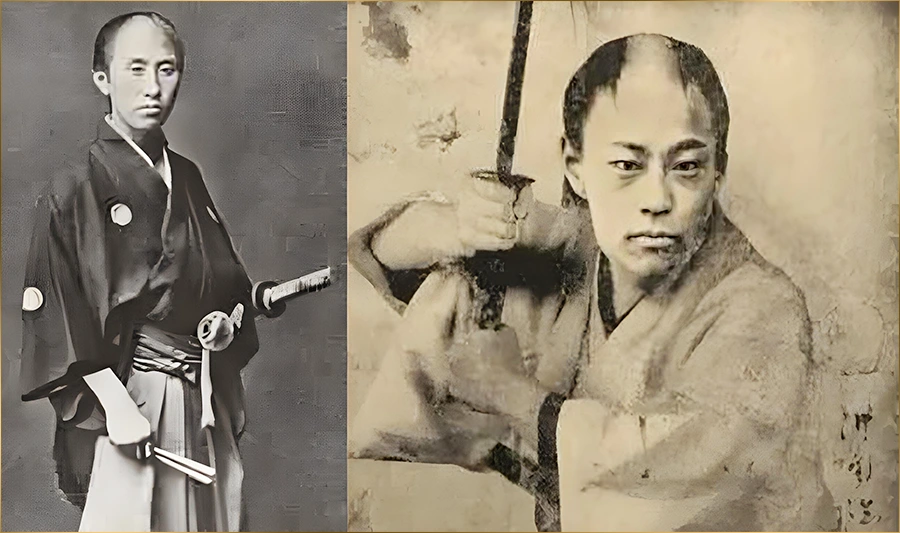
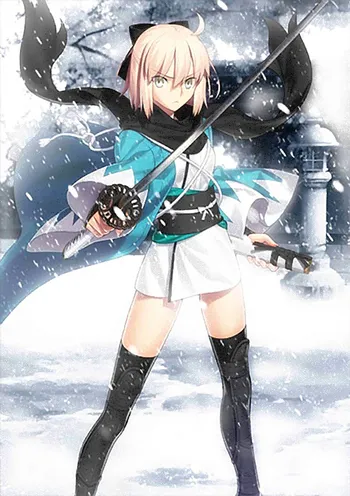
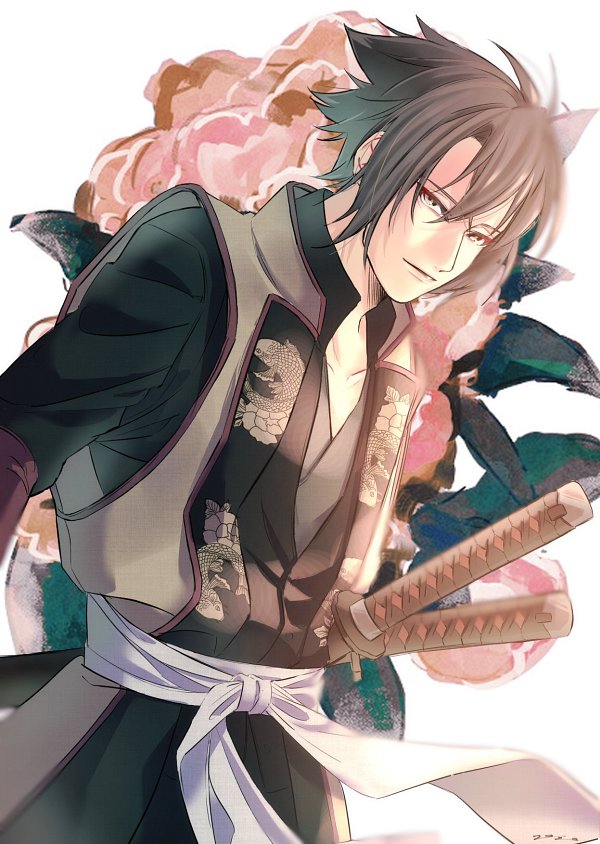
Above, you will see three pictures depicting the SAME person. Okita Souji. I love Okita Souji, he was touted as the most talented swordsman of the Shinsengumi (The Shogunate Secret police force of Kyoto), and was also the youngest, only being 19 when the group arrived in Kyoto. He is in modern Japan one of the most legendary and well known Samurai in history, known for his swordsmanship, honor, and for the fact he died at only 25 from Tuberculosis. Now, Okita Souji, was objectively a horrible person. He participated in the Secret Policing of Kyoto, he was part of assassinations, intimidations, torture of locals and prisoners for information, however, despite that he is in the modern day one of Japan’s most beloved figures to the point where my Japanese teacher who grew up in Japan said he was her favorite samurai.
The above picture on the left, depicts Okita Souji in Fate Grand Order, and as we can see, he is now a she. The in game/show this is explained as in legends, Okita was ‘so incredibly beautiful and lean’, that he was actually a woman who was mistaken as a man, so they decided to depict him as a woman. On the right, is Okita Souji from the hit anime and visual novel Hakuouki. Hakuouki is a visual novel/dating simulator, where all the members of the Shinsengumi are depicted as beautiful men, typical ‘heartthrobs’ who you have to choose between. These two depictions of Okita are easily the most popular and well known in Japan. However, the man in the middle, is a picture of the REAL Okita Souji…yeah, a bit different then the cute anime girl or hot boy heartthrob he’s depicted as my Japanese people today.
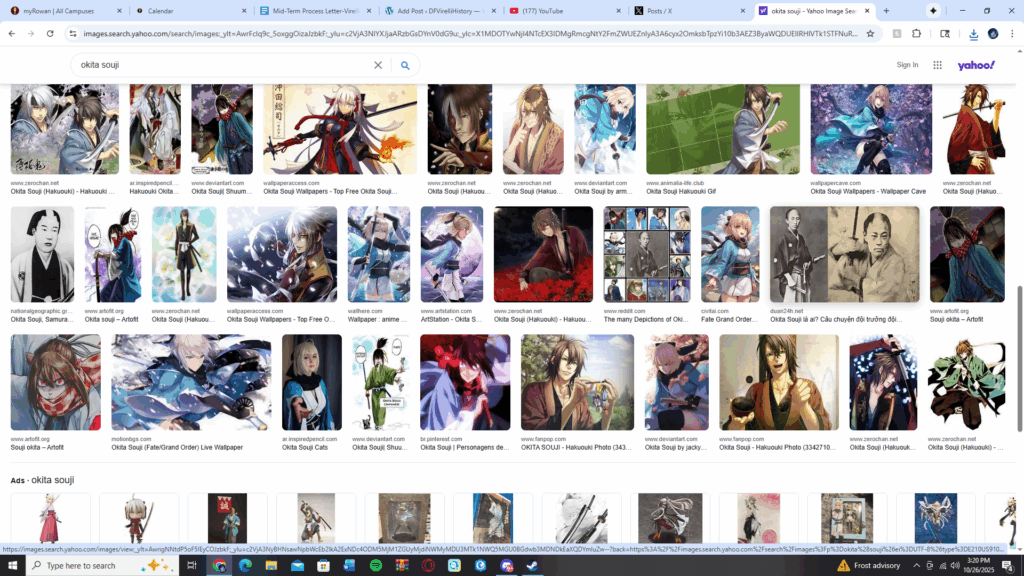
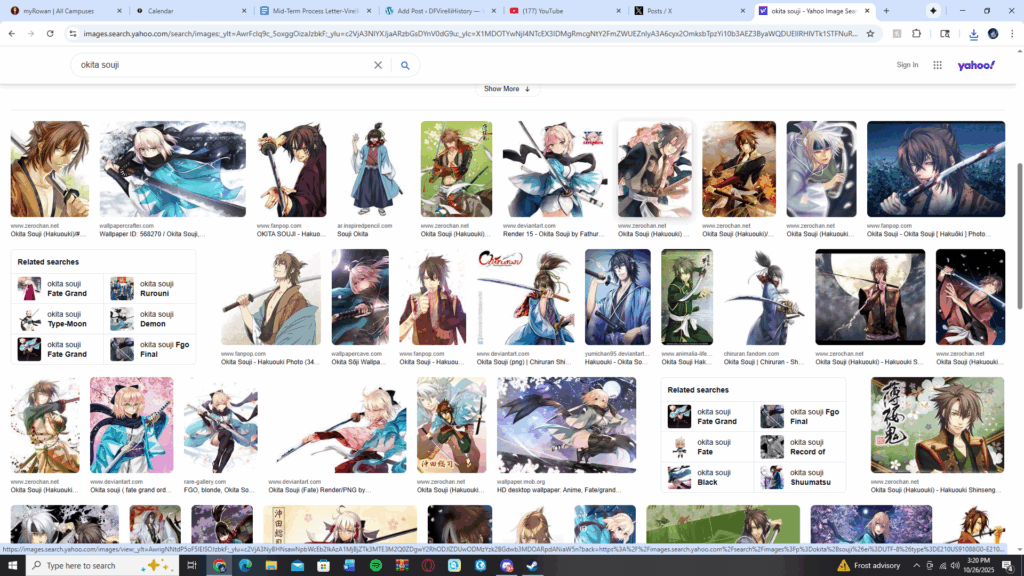
These depictions of Okita are SO popular that when I was looking for a picture of the real Okita to add into this blog post, there were around FORTY TO FIFITY results before it showed up, and of course this is after I scrolled past all the advertisements for Okita Souji merchandise.
So, again, I ask the questions, why in the world is one of Japan’s most legendary samurai a cute anime girl?
The answer, I believe lies in the immediate aftermath of the Meiji Restoration in 1868. A temporary Imperial Government took over in the immediate aftermath of the Boshiin War (1868-1869) which was the official war between the two sides backed by European and Western powers on either side. The Shogunate collapsed, and Feudalism was gone, but in reality it took the new government over 20 years, and ANOTHER war, to finally have a new constitution and official style of government in place. They would eventually settle on a Parliamentary system based off the German model, but during that twenty year period, the remnants of both sides of the war, former samurai, regular common people, wealthy oligarchs, people needed some kind of common ground. And when was the last time that the country was even semi united? The end of the Tokugawa Era. By the 1880s and 90s, the events of the Bakumatsu, the early Meiji and late Edo eras, had receded sufficiently enough in time, to qualify for the time honored tradition that occurs not just in Japan, but around the world, of being used to serve, esteem and blastpheme the present. Figures like Okita Souji, the Shinsengumi, Sakamoto Ryoma and Saigo Takamori, people on both sides of the era, were used to justify the events of the present.
This continued on into the 20th century, and picked up even more in the Nationalistic, Imperialistic years leading up to World War 2, and during the years following. Things like the amazing samurai era period pieces by Akira Kurosawa, historical fiction novels by Ryotaro Shiba, and even K,C, and J dramas (Korean, Chinese, Japanese drama shows) my teacher watched as a child, brought back the past and ingrained figures like Okita Souji into modern Japanese culture.
And all of this adoration, particularly of the figures from the Bakumatsu and Meiji era, began in Kyoto during that 15 year period. So, while I was not able get any work done on the computer, between listening to my audiobooks on the way to work, reading snippets during breaks, I’ve refreshed myself on many of the events I’ll be including, and on what it was about the time period I grew to find so interesting.
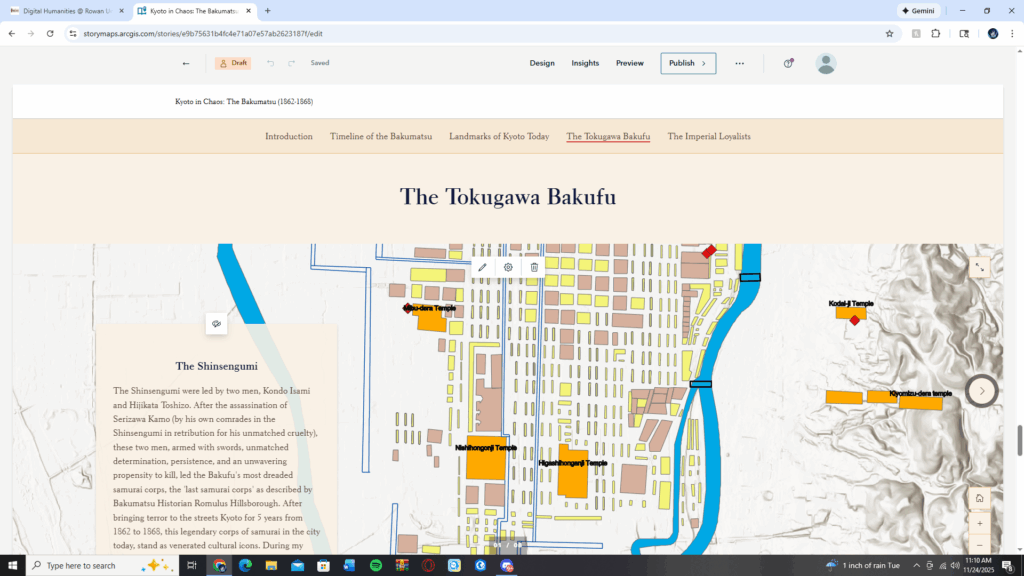
The Kamogawa River, more commonly know as simply ‘The Kamo River’ has been one of the dozens of cultural landmarks of Kyoto for over a thousand years. Not only is Kyoto cleverly nestled in between mountains, it also has this great river snaking around it. I was lucky enough to walk along its banks during my trip to Japan in May. In our first night in Kyoto, while most of my friends on the trip, decided to go to Gion and other night districts, I had one place in mind I wanted to visit. Sanjo Bridge, which stretches out over the Kamo River, and home of the Ikedaya Inn. The Ikedaya Inn was the home of the most famous confrontation in Kyoto between the Imperial Loyalists and the forces of the Tokugawa Shogunate.
This radical group of Loyalists were days away from initating a plan called ‘The Great Kyoto Fire’. The plan was for them to set fire to the Imperial Palace and surrounding area in Kyoto. During the chaos they would swarm inside the palace, and kidnap Emperor Komei himself and take him back to the Tosa or Choshu domain, the centers for Imperial Loyalists activity. This plot was foiled by the Shinsengumi, lead by Kondo Isami and Hijikata Toshizo. After torturing a Loyalists prisoner, they discovered the group would meet at the Ikedaya to plan the final details of their attack. The Shinsengumi destroyed this group, and arrested some while disposing of others with their swords or in the Kamo River itself.
I walked along the banks where there are plaques to indicate the battle that took place at the no longer standing Ikedaya. In the following days, the heads of Loyalists samurai killed in the raid were mounted on spikes in the mud of the river. This was common practice, as the river was a popular spot for attacks and assassinations. Making it vital to not just the city, but the Bakumatsu Period as a whole.
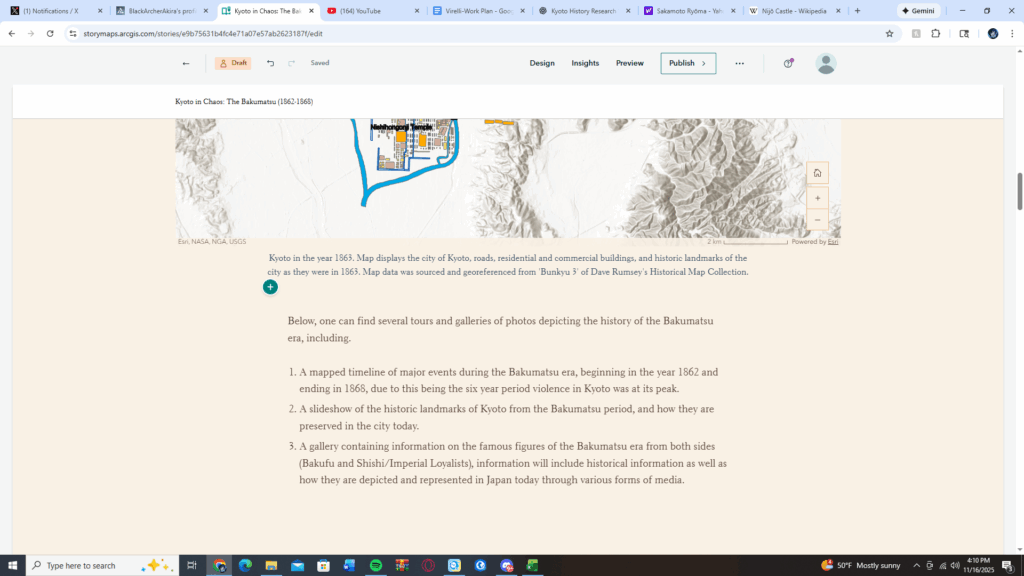
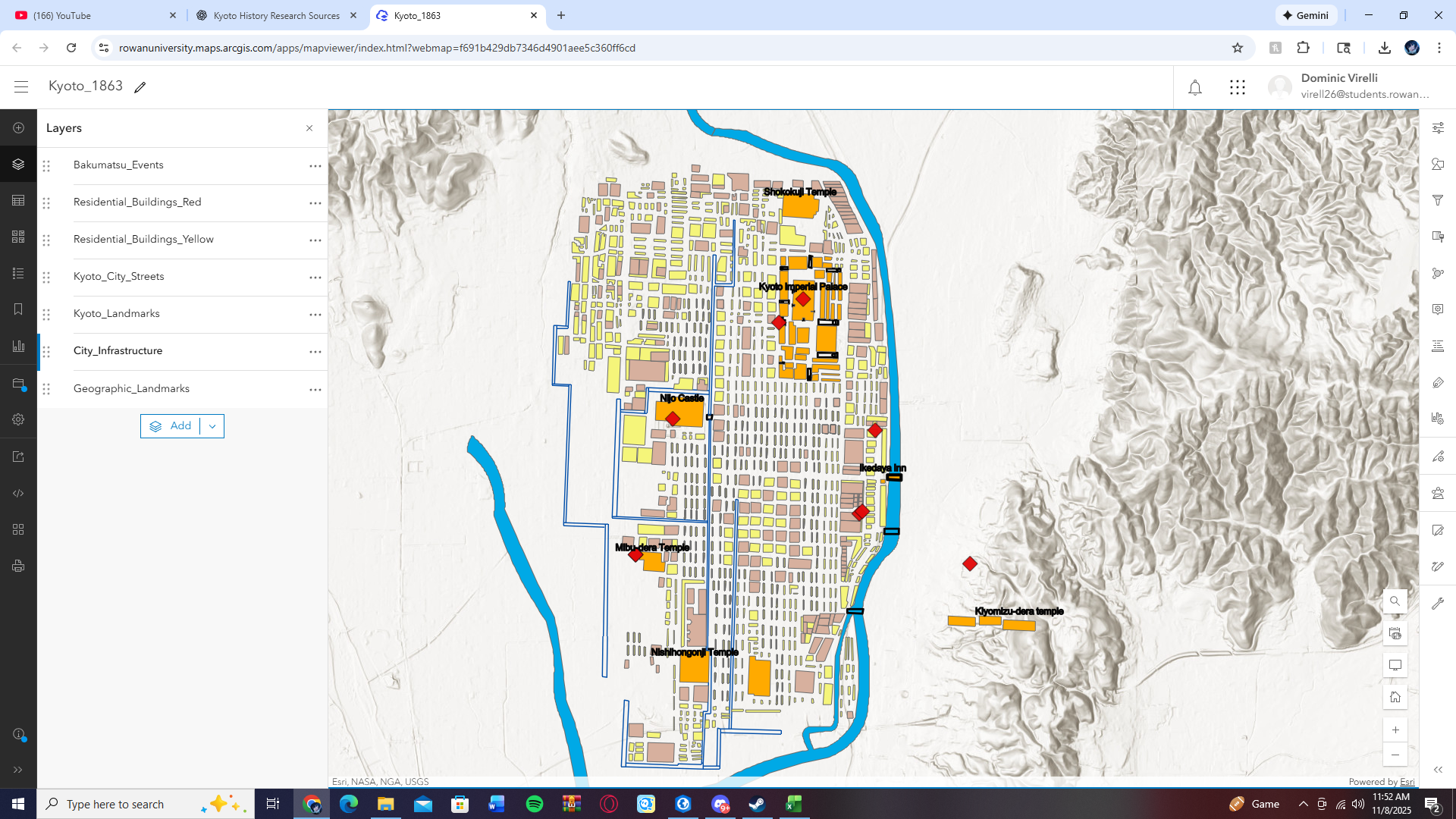
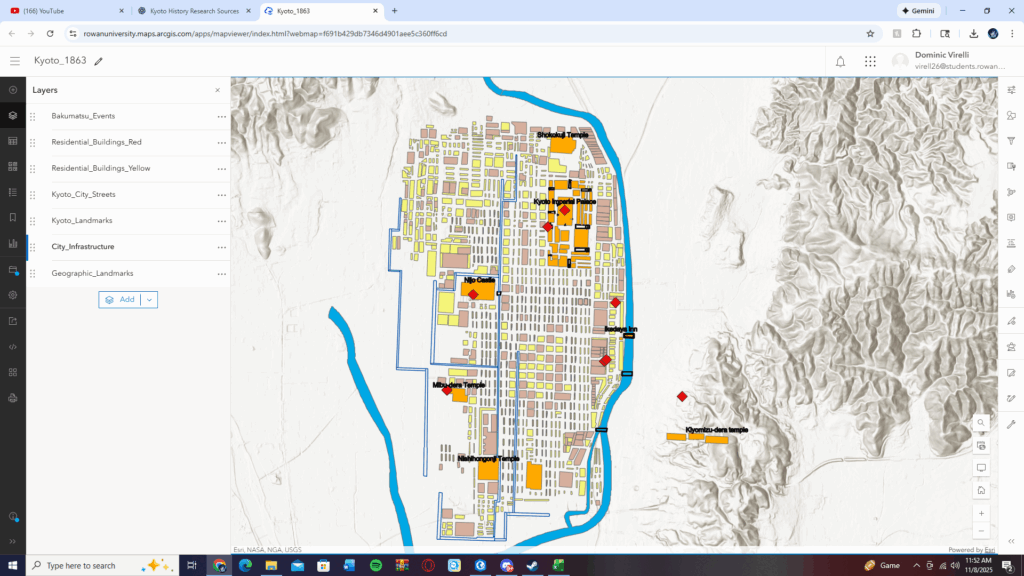
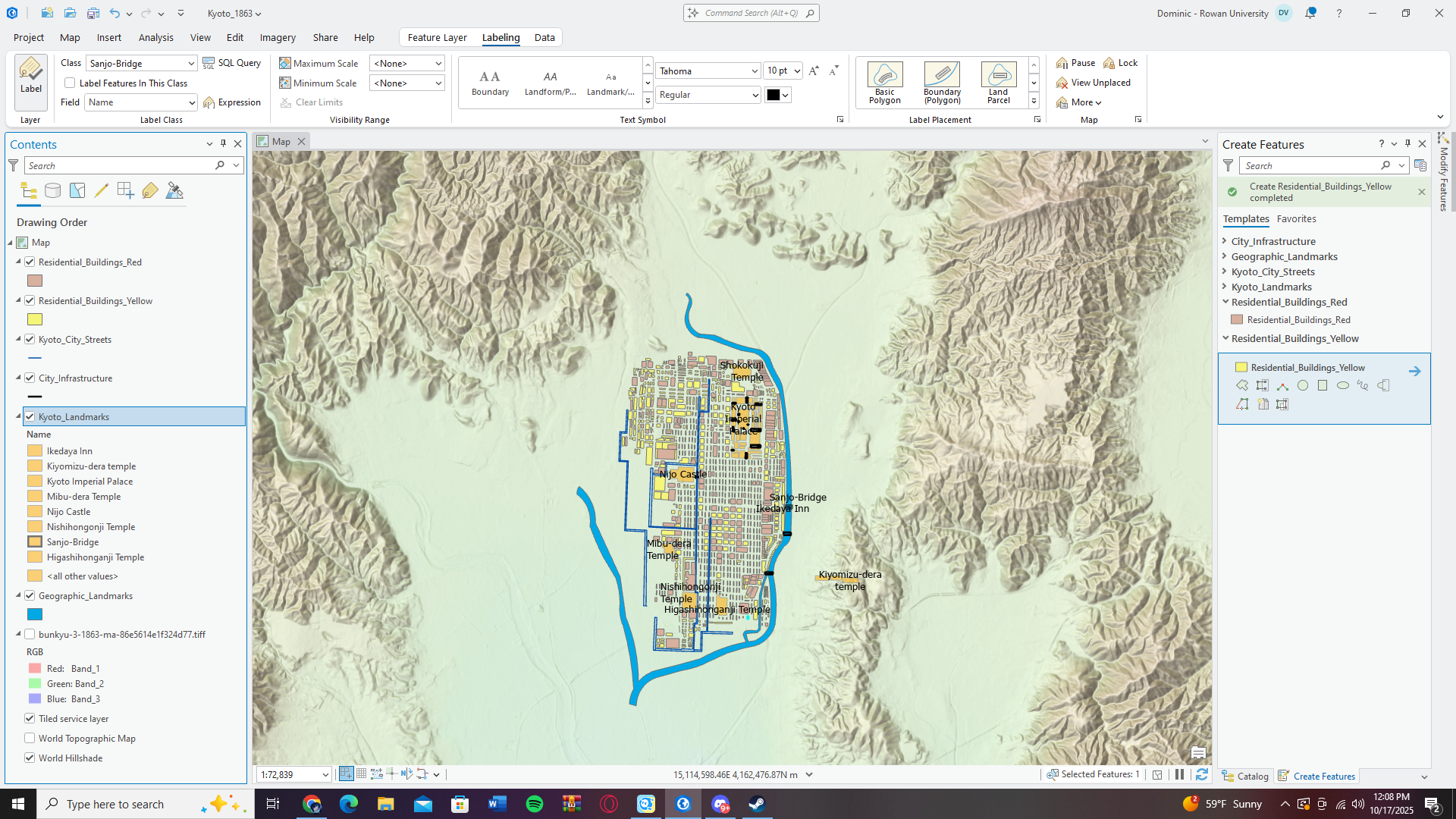
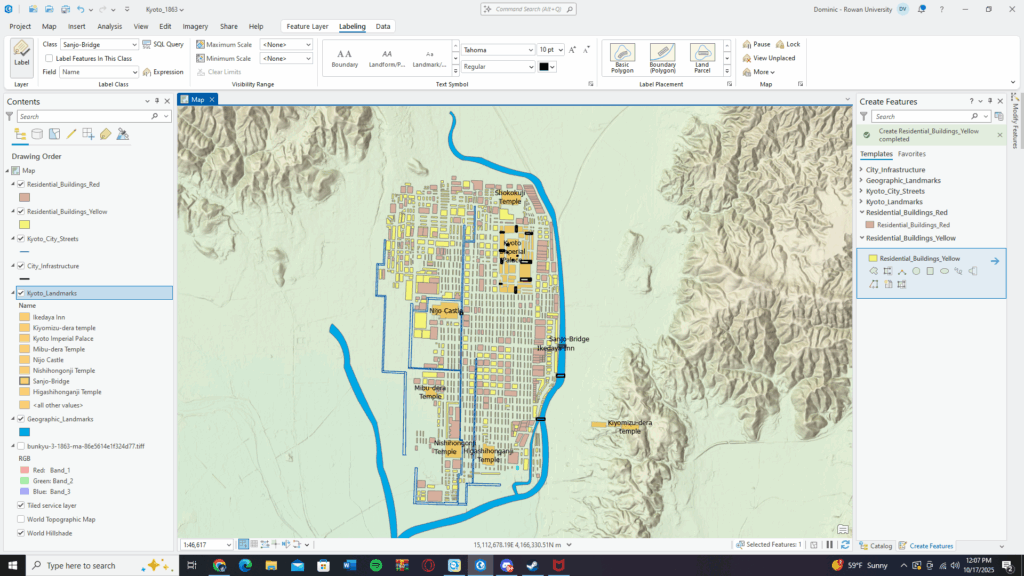
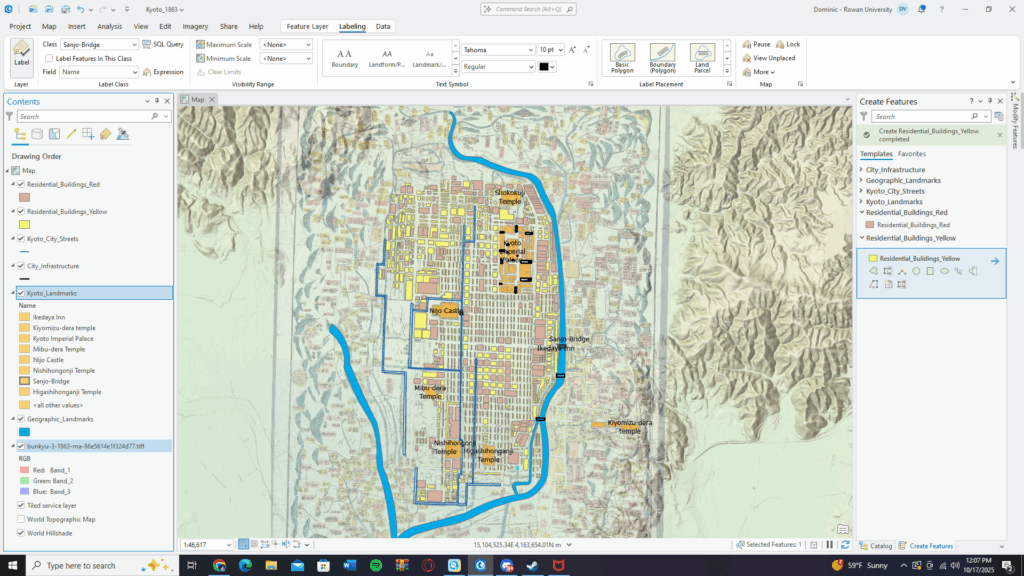
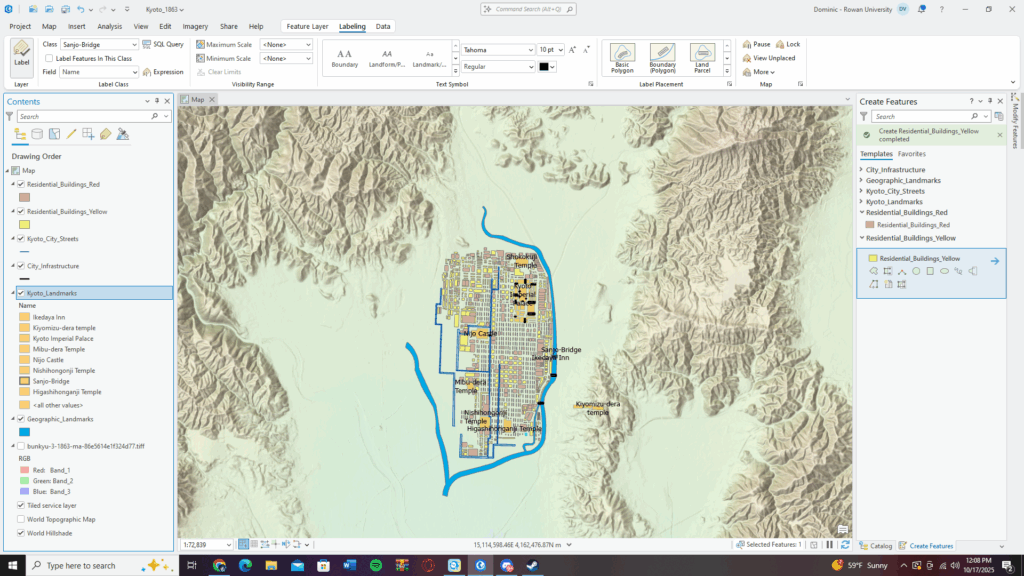
It also serves as the boundary line of Kyoto during this time, and thanks to me finally finishing the city map is temporarily ‘complete’. After adding the labels for the major landmarks, I can finally take a break from the map itself. The river was hard to manage with its curves, and I still think there are areas of it where I want to edit and fix the angles, but I’m going to save that for the last few weeks when I plan on having time for strictly edits to the map. I also think this combined with work for Dr. Saladin has given me burnout from ArcPro, so being able to put the map aside for a week or two will be nice.
Now, however, I can go right into the story map, and create the csv spreadsheet for the points of conflict before the story map gets going. The one semester I was able to actually write about Japanese history and the Bakumatsu was in my undergrad seminar with Dr. Hague, and that while stressful, was an amazing semester of writing. I’m really excited to finally be able to tell people about this time period I’ve studied for so many years now.
Now, however, I have both my job at Eastern State, AND my new one at the Constitution Center until the end of October. So it’s safe to say things are going to be a bit packed schedule wise, but I’m confident I’ll be able to keep up my pace… at least I hope.
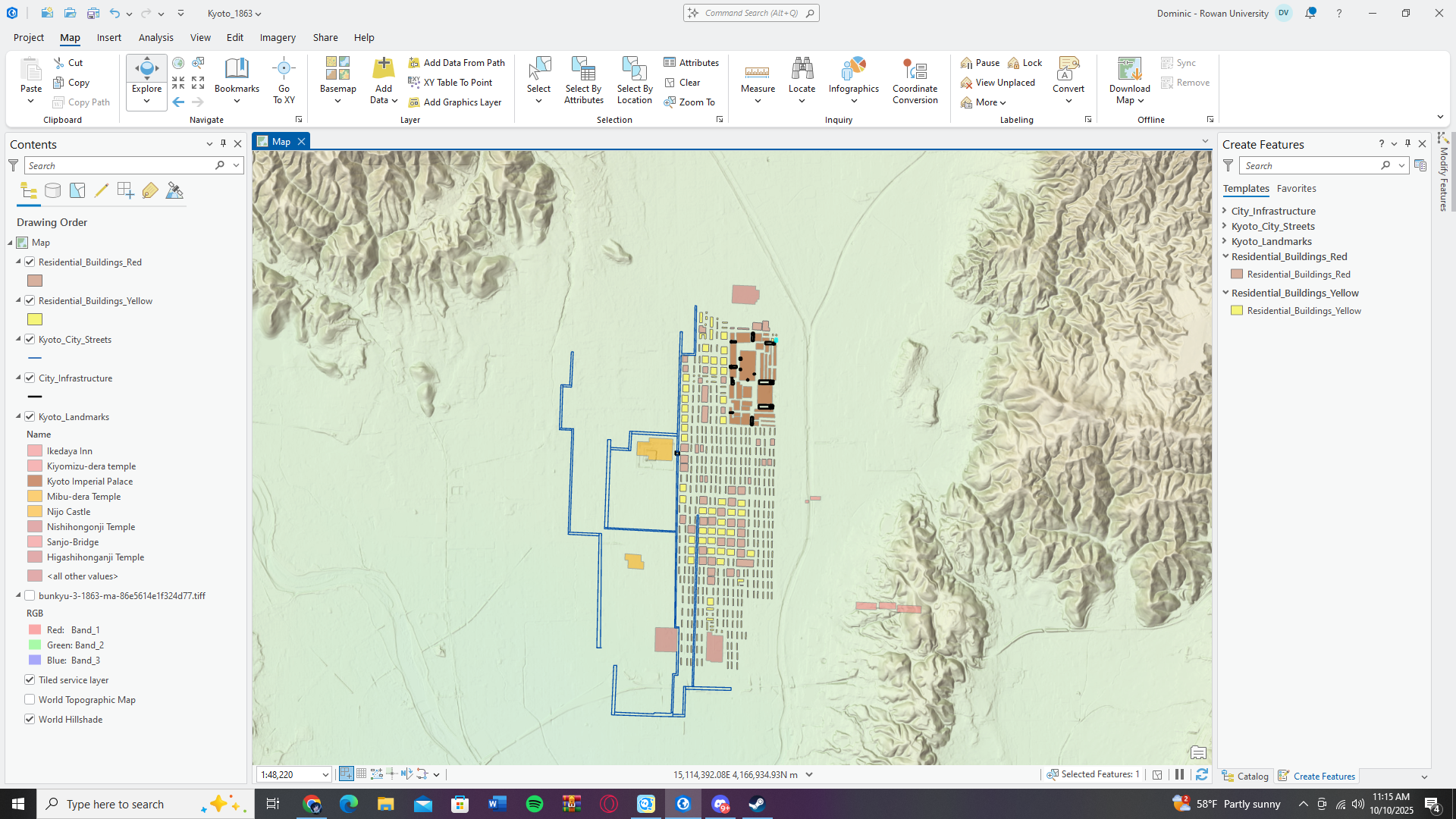
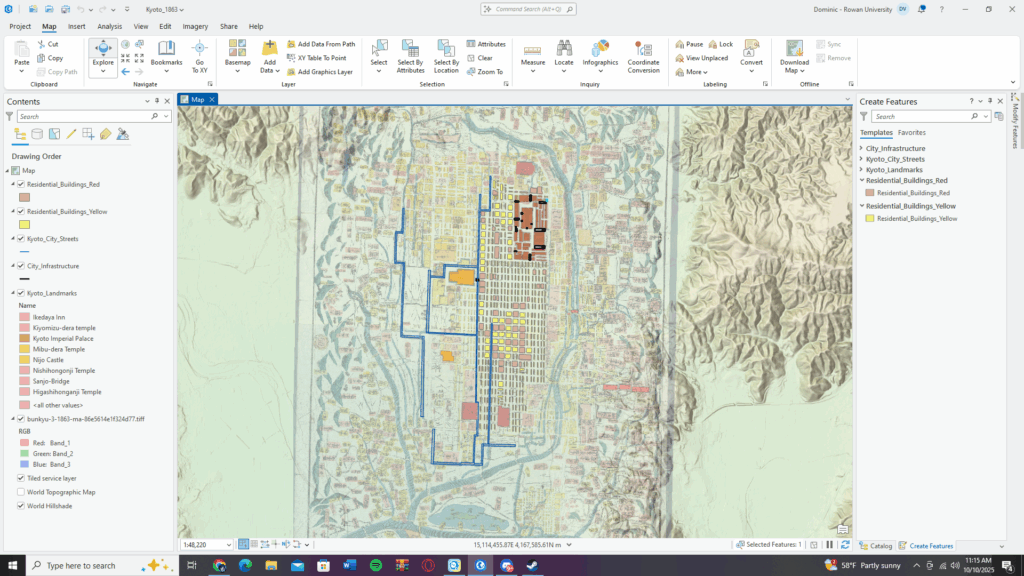
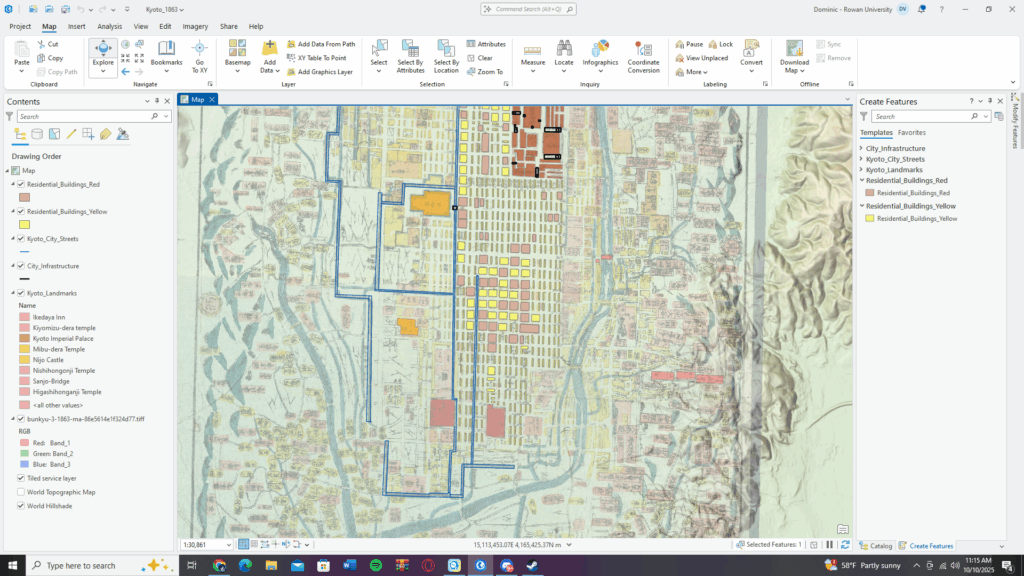
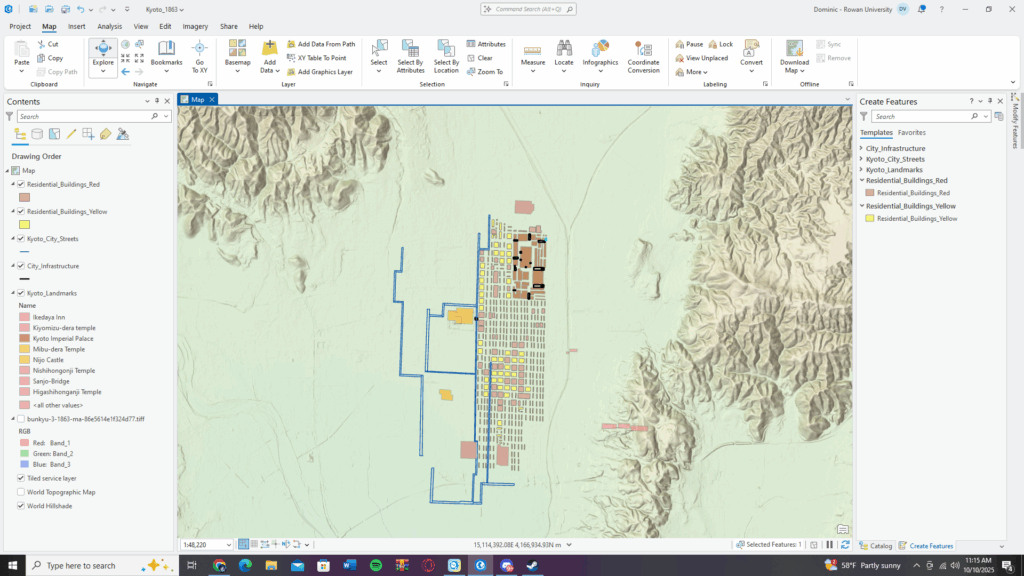
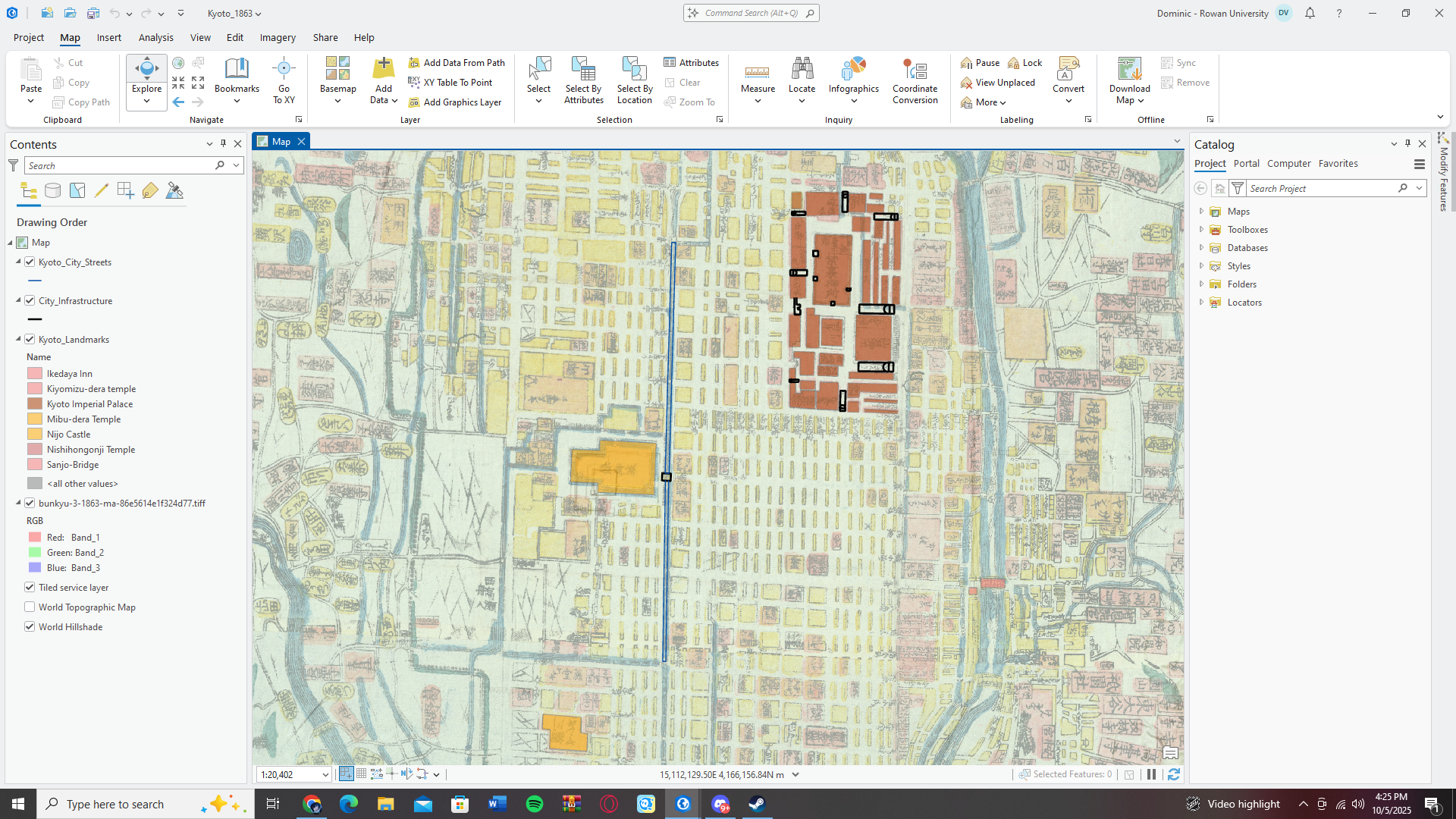
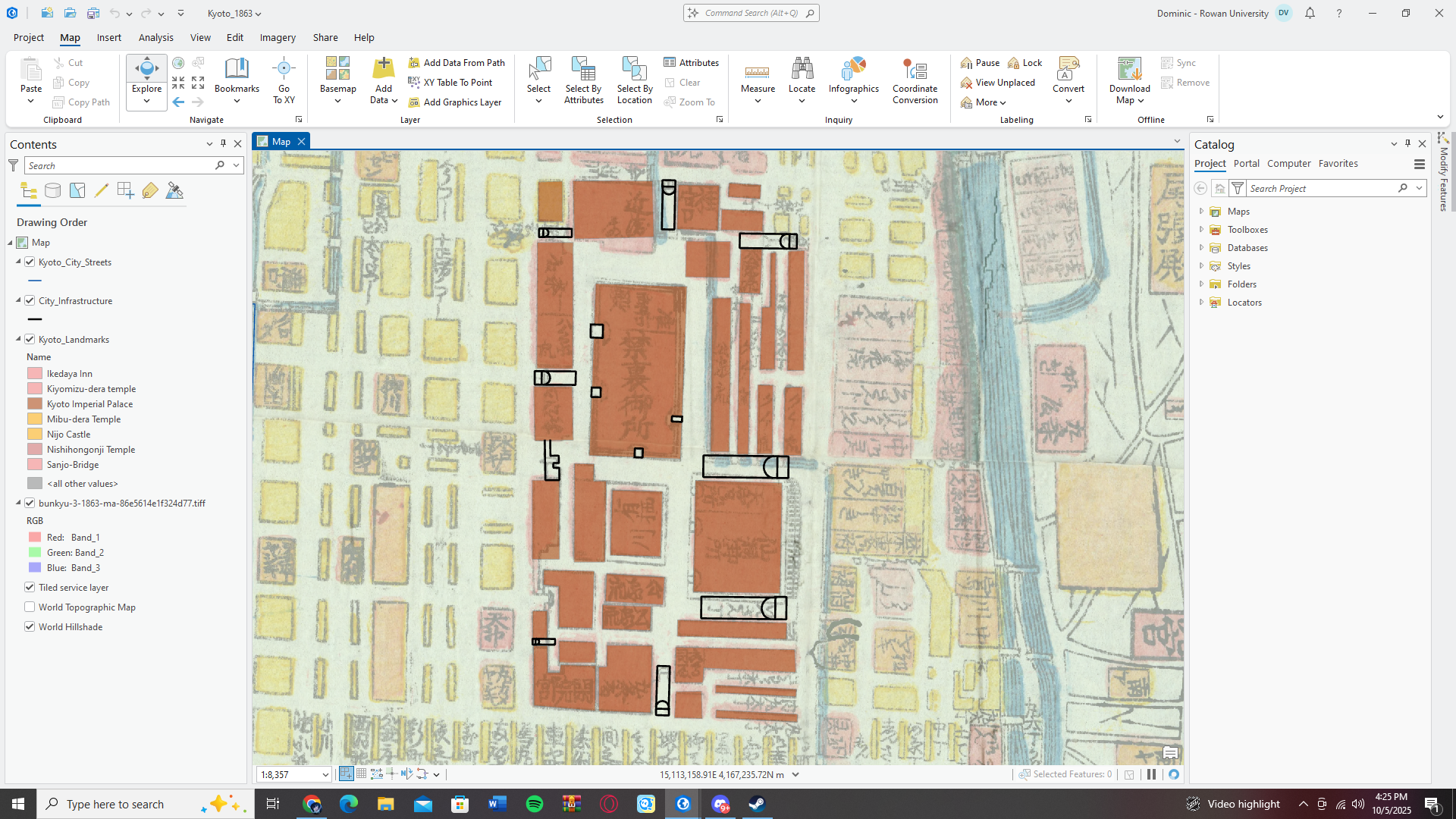
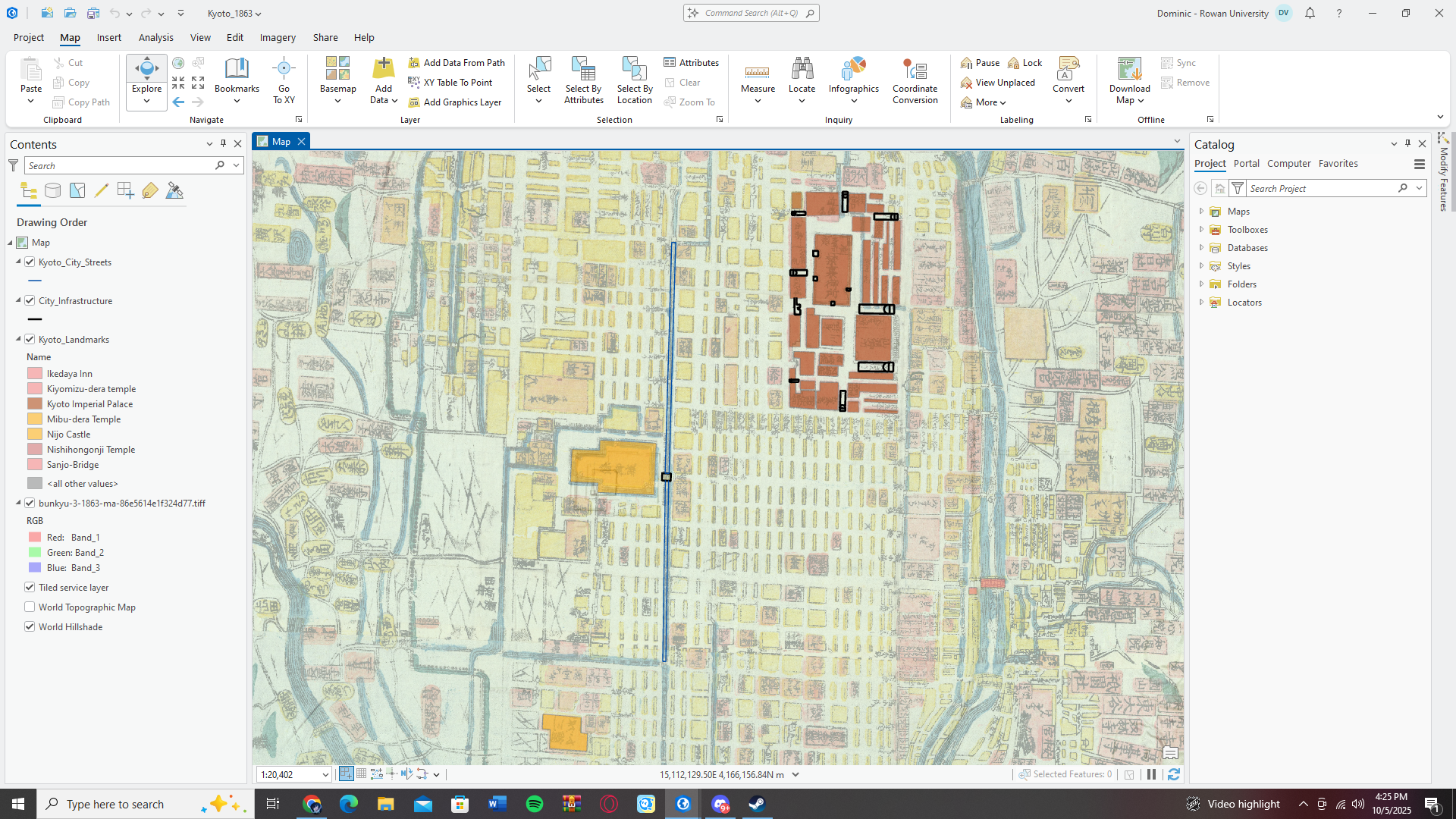
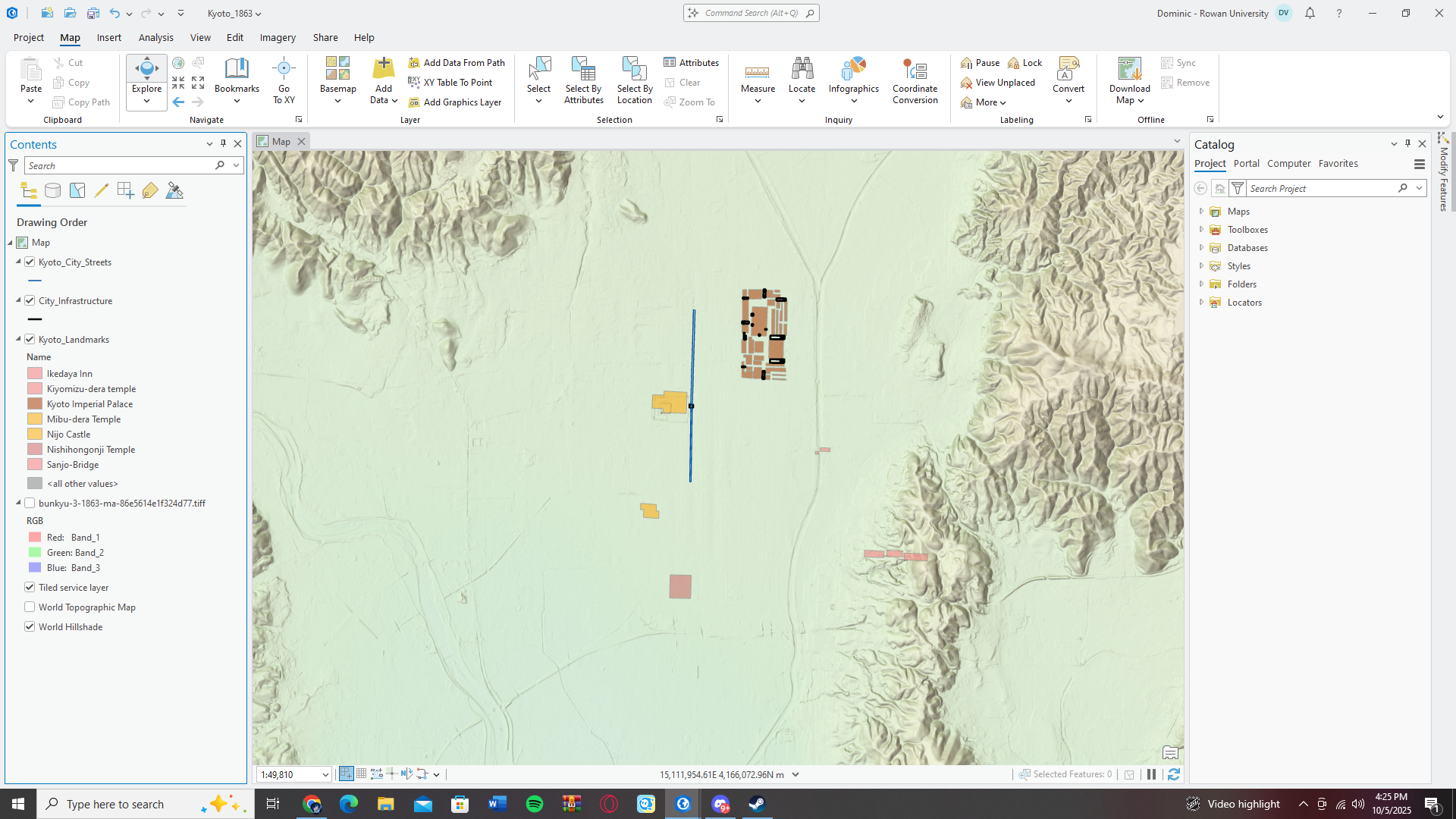
I have finally reached a point, where I’ve mastered the very difficult to master art of drawing polygons and straight lines on ArcPro. At first whenever I turned off my reference map, you’d see nothing but barren land with only the Imperial Palace visible, but now that the straight lines have been conquered and the residential buildings are being filled in we can see the outline of the city. Since it is nestled between the two rivers, once all the buildings are traced, and I get the rivers down, it’ll finally give viewers the scope of the cities lay out. After that is when I move onto the spreadsheet with my control points, and then the StoryMap which is what I’ve been most excited to get to in this process, since it will scratch my itch and desire to truly write about th Bakumatsu Period.
The major streets around the city are finished, and the only thing left to really trace besides the rest of the buildings are the rivers,
The residential buildings themselves were a bit tedious to trace, but thankfully I have the power of copy and paste, I was able to copy longer rows of the buildings and paste them back on the rest of the map. I mentally separated the city into thirds around the streets, and now I’ll hopefully be finished by next week and I can set the map aside for a while. I’ve learned after years of doing assignments like these sometimes it’s good to just put something to the side for a while before jumping back in. I’m also still a week ahead of schedule thanks to Dave Rumsey already having the map of Kyoto georeferenced, that means I don’t have to rush through the rest of the tracing process. I am thankfully going to have an extra week at the end of the semester before presentations to really edit the map and straighten things out. Getting to the next phase is really going to be exciting since it’s more traditional research which is going to be a nice change of pace.
It really is satisfying to finally be able to turn off the map layer that I’ve been tracing and begin to see the city itself really come to life. The rivers are going to be the hard part, and I think that’s going to have to be something that I go to Dr. Saladin for help for, since I’m not exactly sure what drawing tool would be best to use it since it does snake around the city. The bridges are important for some of the biggest incidents and events during the period, and since they go across the river the river is pivotal to include. Still, while I’m not exactly sure how I’m going to draw it appropriately, I guess you can say I’ll cross that BRIDGE when I come to it.
On a more personal note, I am very happy to say I did get offered the job at the Constitution Center, and yes the National Treasure jokes were abundant when I first told people. I’ll be in visitor engagement and education, so I’ll be moving to another museum in Philadelphia with a great reputation. I was told by the wonderful people who interviewed me, that all the museums in Philadelphia are always in contact and are recommending people for positions, so all I have to do it do the job I know I can do, and who knows, the future is bright.
When I first started learning the ArcPro tools, one of the best things about it was one simple fact. It draws lines for me and they are always straight. I can angle them myself of course, to make them face certain directions, but all I have to do is place two control points and the line will connect without me having to draw the line between them. So, when it came to drawing the first of Kyoto’s major streets I thought initially it would be easy, however the most difficult parts are aligning the straight lines with the map that I’m using for reference. For context the map I’m using is hand painted, so the streets and buildings themselves are not all completely straight and the same length. So, as a result some of the street lines and tracings of buildings aren’t exactly one for one with my reference map.
The second ‘line difficulty’ this week, was when I started tracing the different gates of the Kyoto Imperial Palace compound. The palace compound which by the year 1863 had served as the home of the Imperial Family for over a thousand years had a series of gates surrounding not just the larger compound but the inner palace itself. Many of the gates were the subject of rebellions, fights and fires, the most famous being the ‘Kinmon Incident’ or the ‘Hamaguri Gate Rebllion’, where an army of three thousand men from the Choshu domain attempted to defeat the Tokugawa forces in the Imperial Palace. They intended to kidnap the Emperor away from the Tokugawa forces who they believed were corrupting him and wanted to return him to full power. In the process, they burned dozens of surrounding houses despite being soundly defeated. So, this event is going to be recorded in my story map, making the Hamaguri Gate something I have to include. Thankfully, Dr. Saladin has shown me how to copy and move over the different polygons and line tracings I draw, so I only have to draw them correctly one time.
Thankfully the only streets I’ll have to draw are the long major roads. The rest of the smaller side streets are going to naturally be filled in when I start tracing the smaller buildings. Everything on the outside of the two rivers surrounding the city I believe I’m going to leave out unless I discover there is an incident there I want to record. So, by the time my desired deadline for finishing my tracing comes next week, I believe I’ll have it done, and I can get on to the Story Map and spreadsheet of the different incidents which is what I am most excited for. So, straight lines will only hamper me for a little bit longer.
On a more personal note that also has to do with Digital Humanities, I’m in the interview process with the National Constitution Center in Philadelphia. The position is a near full time (30-32 hours a week) position, as a Museum Educator, and during my initial interview when I mentioned I was in the middle of a Digital Humanities COGS, my interviewer was interested and when I described to her my capstone and other projects, she told me she-just like me for this project- has used Dave Rumsey’s georeferenced historical maps for her projects before. She said there was and could be plenty of opportunities to assist the exhibits and education department in different digital projects. I think this was a large part of the reason I believe I was able to get my second interview, I should know by class on Monday October 6th how well everything is going to go. This could be the start of a real career which is always exciting!