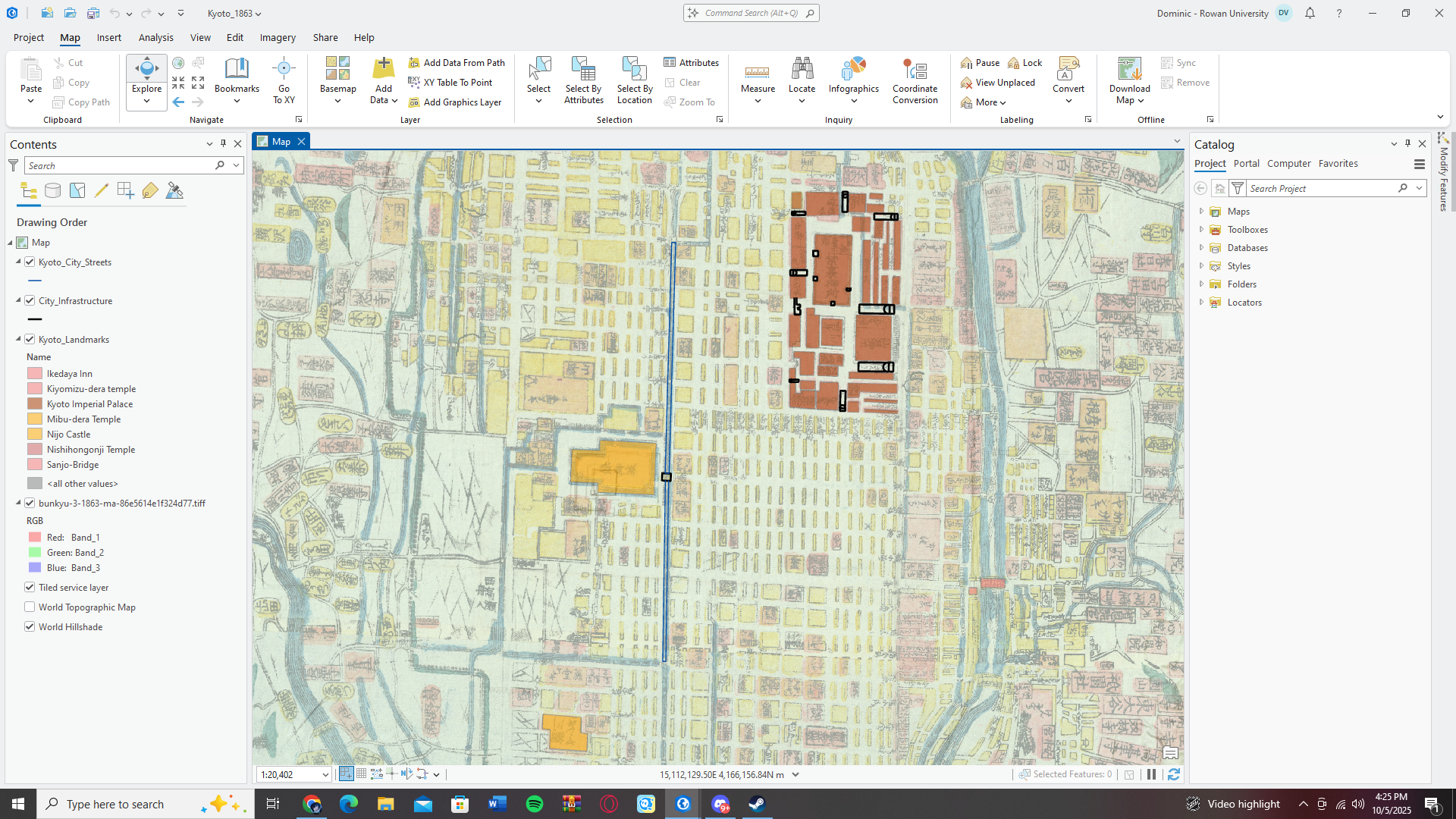
When I first started learning the ArcPro tools, one of the best things about it was one simple fact. It draws lines for me and they are always straight. I can angle them myself of course, to make them face certain directions, but all I have to do is place two control points and the line will connect without me having to draw the line between them. So, when it came to drawing the first of Kyoto’s major streets I thought initially it would be easy, however the most difficult parts are aligning the straight lines with the map that I’m using for reference. For context the map I’m using is hand painted, so the streets and buildings themselves are not all completely straight and the same length. So, as a result some of the street lines and tracings of buildings aren’t exactly one for one with my reference map.
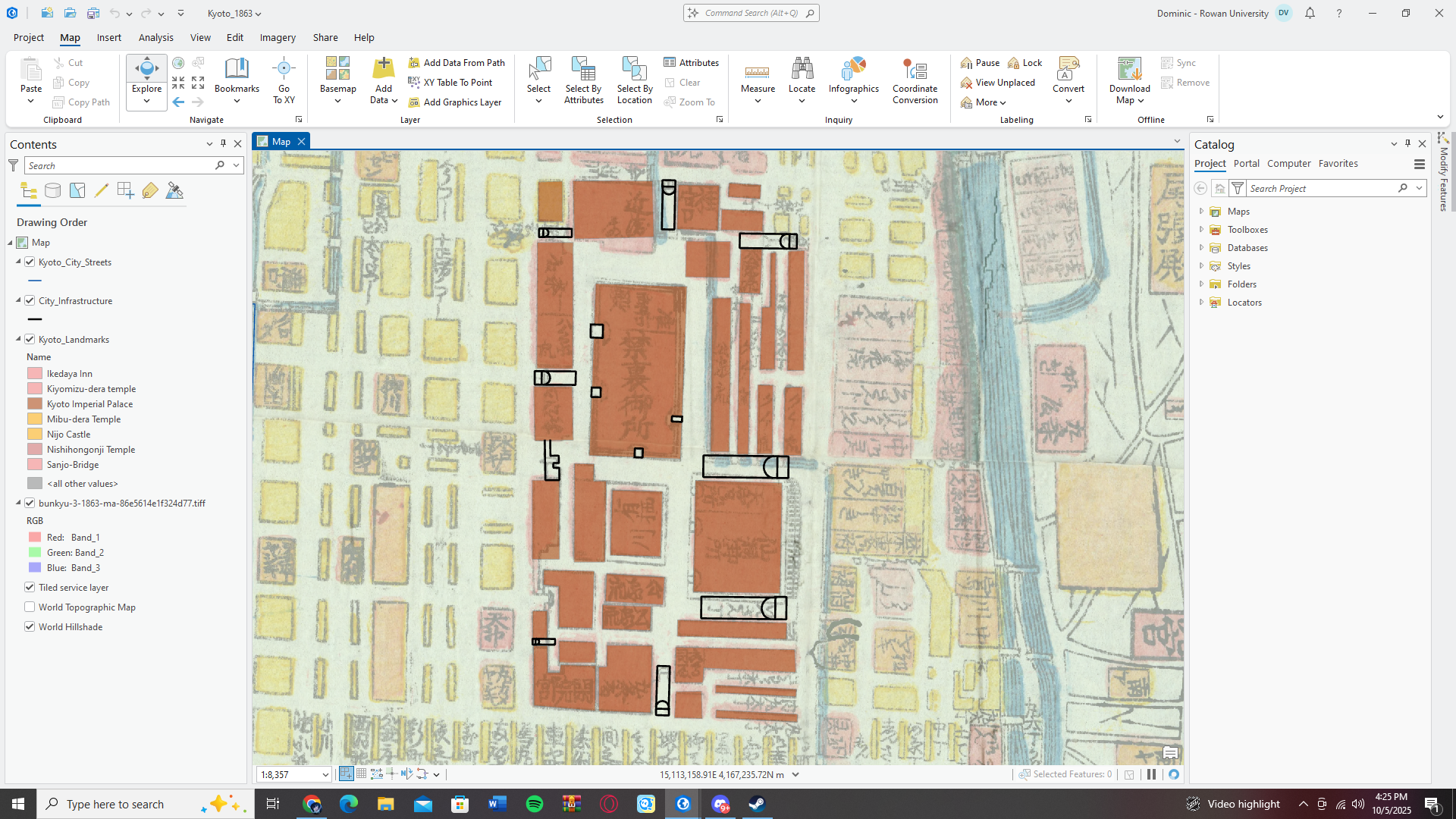
The second ‘line difficulty’ this week, was when I started tracing the different gates of the Kyoto Imperial Palace compound. The palace compound which by the year 1863 had served as the home of the Imperial Family for over a thousand years had a series of gates surrounding not just the larger compound but the inner palace itself. Many of the gates were the subject of rebellions, fights and fires, the most famous being the ‘Kinmon Incident’ or the ‘Hamaguri Gate Rebllion’, where an army of three thousand men from the Choshu domain attempted to defeat the Tokugawa forces in the Imperial Palace. They intended to kidnap the Emperor away from the Tokugawa forces who they believed were corrupting him and wanted to return him to full power. In the process, they burned dozens of surrounding houses despite being soundly defeated. So, this event is going to be recorded in my story map, making the Hamaguri Gate something I have to include. Thankfully, Dr. Saladin has shown me how to copy and move over the different polygons and line tracings I draw, so I only have to draw them correctly one time.
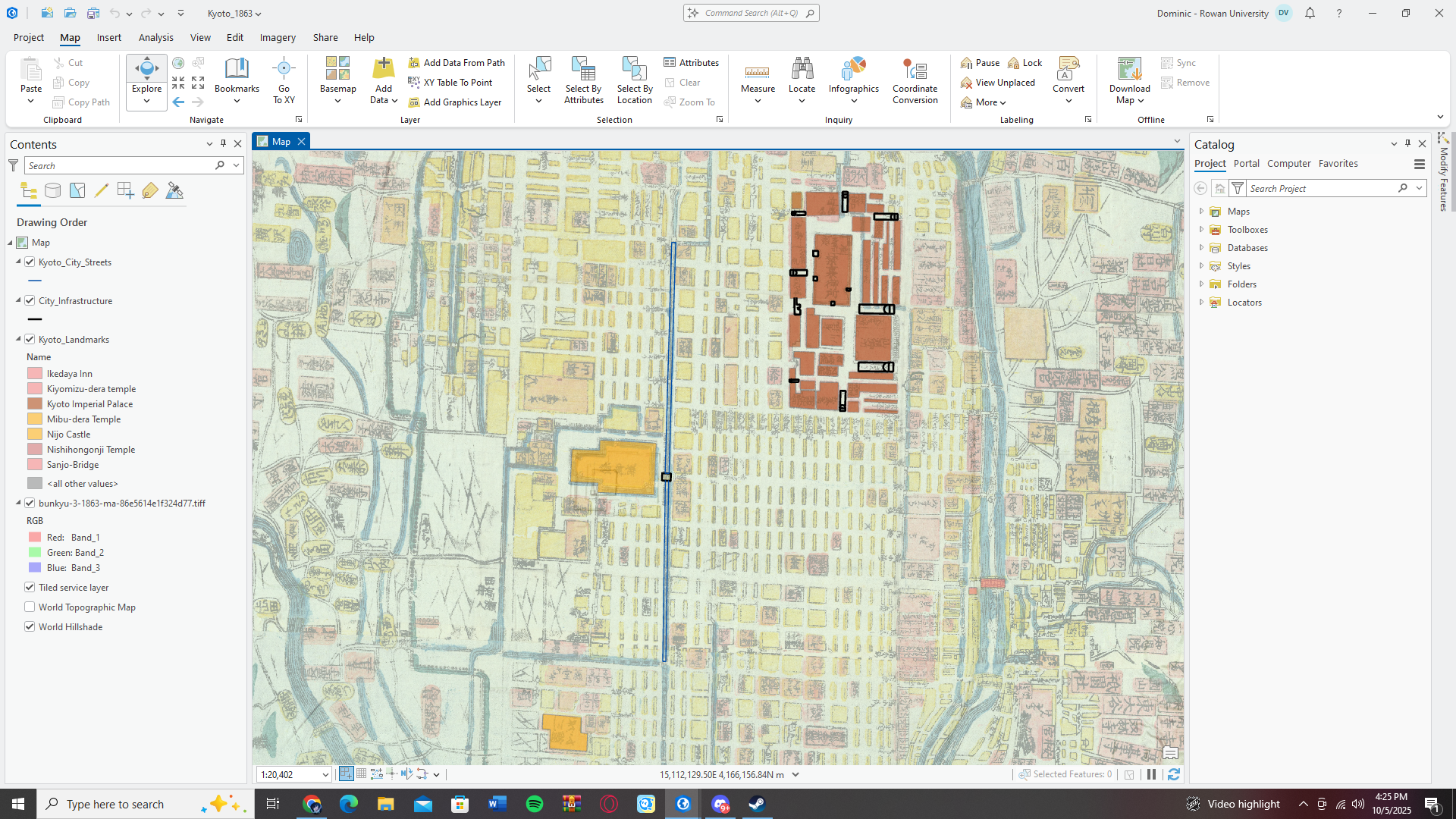
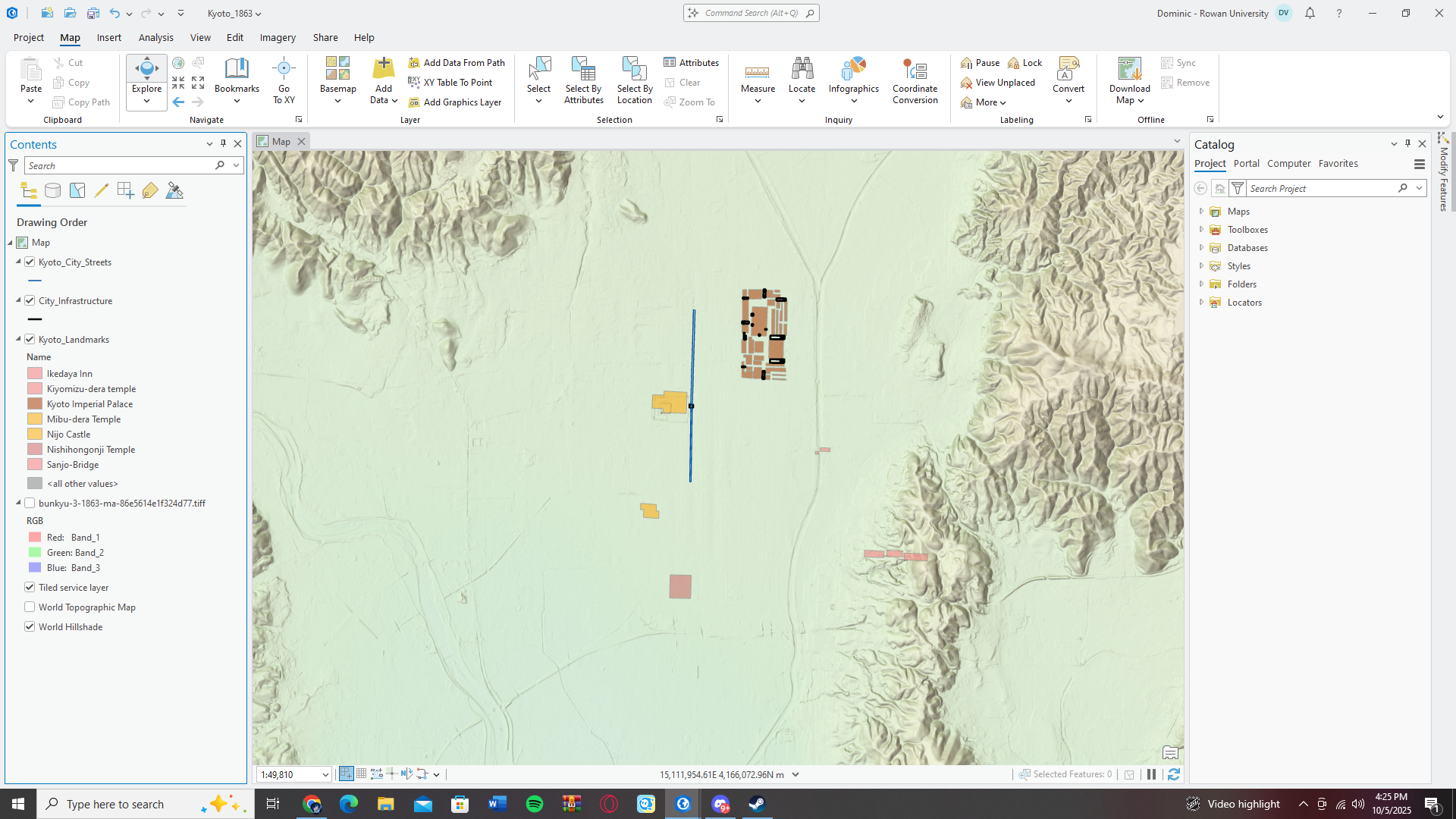
Thankfully the only streets I’ll have to draw are the long major roads. The rest of the smaller side streets are going to naturally be filled in when I start tracing the smaller buildings. Everything on the outside of the two rivers surrounding the city I believe I’m going to leave out unless I discover there is an incident there I want to record. So, by the time my desired deadline for finishing my tracing comes next week, I believe I’ll have it done, and I can get on to the Story Map and spreadsheet of the different incidents which is what I am most excited for. So, straight lines will only hamper me for a little bit longer.
On a more personal note that also has to do with Digital Humanities, I’m in the interview process with the National Constitution Center in Philadelphia. The position is a near full time (30-32 hours a week) position, as a Museum Educator, and during my initial interview when I mentioned I was in the middle of a Digital Humanities COGS, my interviewer was interested and when I described to her my capstone and other projects, she told me she-just like me for this project- has used Dave Rumsey’s georeferenced historical maps for her projects before. She said there was and could be plenty of opportunities to assist the exhibits and education department in different digital projects. I think this was a large part of the reason I believe I was able to get my second interview, I should know by class on Monday October 6th how well everything is going to go. This could be the start of a real career which is always exciting!
And it’s in part thanks to digital Kyoto!

Leave a Reply